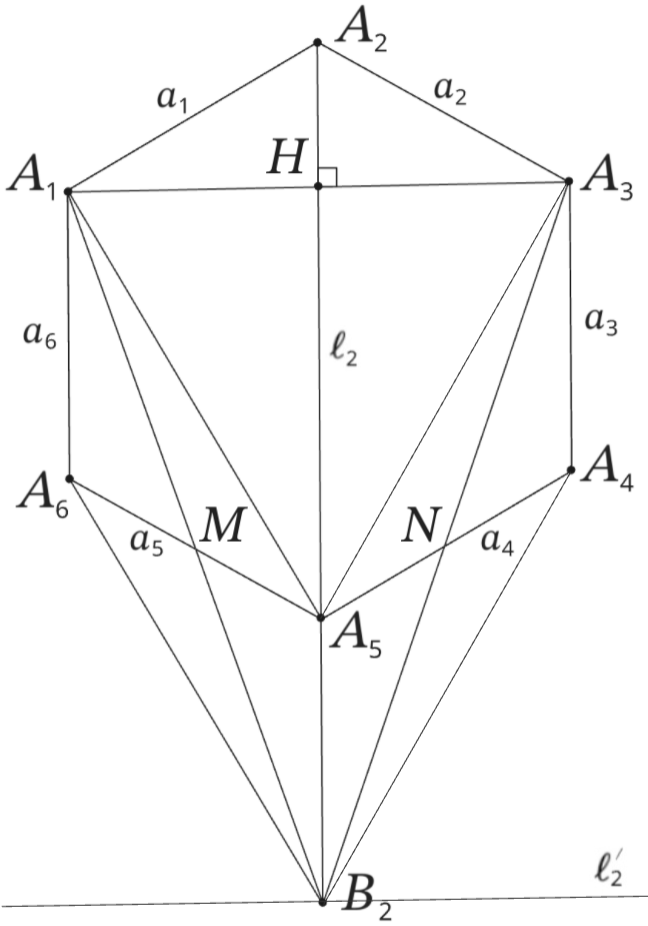
This work fills a 2000-year-old gap and is the structural “missing link”: Heron's formula dates back to ∼60 AD and Bretschneider's formula to 1842, yet no such unified formula existed for polygons with more than 4 sides. This work shows that these two formulas—which looked completely different for centuries—are particular cases of a single general formula. The remarkable thing is not that it uses only side lengths and certain distances, but rather that one single unified formula computes the area of any convex n-gon for any number of sides n≥3 (which is the key novelty), previously thought impossible for n≥5. This novel formula is overcoming the “impossibility” of rigidity for n≥5. Applications include distance geometry, knot theory, drone networks, robotics—where coordinates are unavailable, only pairwise distances are known, and area calculations are mission-critical. The geometrically constructed point B2 can be viewed as a representative point associated with the figure’s area distribution—analogous in spirit to the center of mass, which serves as a representative point for the volume of a three-dimensional body.
Introduction
In computer graphics, geographic information systems, and structural engineering, calculating the area of irregular polygons usually requires breaking them down into a mesh of triangles or using Cartesian coordinates. In many real-world scenarios (flexible structures, robotics, distance-only sensors) coordinates are genuinely unavailable, making this formula not just a niche alternative but the only clean option. This newly discovered formula allows for the area calculation of a flexible or moving convex structure using only distance constraints (sides and specific internal diagonal lengths), bypassing the need to calculate coordinate positions or interior angles. The formula is expressed via a beautifully alternating sum of squared side lengths and a geometrically constructed point B2, which elegantly bypasses the structural flexibility of the polygon by introducing a single reference point relative to the diagonal A1A3. The distance A2B2 accounts for the degrees of freedom of the polygon without requiring trigonometry, coordinates, or triangulation.
Theorem (Sedrakyan's area formula).
The area of a convex n-gon A1A2…An is:
414A1A32⋅A2B22−(a12−a22+⋯+(−1)n−1an2)2
where AiAi+1=ai (indices mod n) and point B2 is described in the Theorem provided in the main result.
Remark. This formula has been presented at international conferences as Sedrakyan's area formula. The formula was initially realized by Hayk Sedrakyan, experimentally verified with Christophe Pinarbasi, and formally proved by Nairi Sedrakyan and Hayk Sedrakyan. The author thanks Christophe Pinarbasi for stimulating discussions. Having recognized the result but lacking a formal proof at the time, the authors have, since 2022, shared this topic with several people; however, none of them was able to prove the result. Nevertheless, the authors would like to thank them for their efforts.
Particular cases (Heron's and Bretschneider's formulas)
Theorem (n=3, Heron's formula). The area AT of a triangle A1A2A3 with side lengths a, b, c is (in the section main results and proofs we show that for a triangle point B2coincides with vertex A1):
In the next section we show that this formula of AT is actually Heron's formula.
Theorem (n=4, Bretschneider's formula). The area AQ of a quadrilateral A1A2A3A4 with side lengths a, b, c, d and diagonals e, f is (in the section main results and proofs we show that for a quadrilateral point B2 coincides with A4):
In the next section we show that this formula of AQ is actually Bretschneider's formula.
Remark. In applied sciences, we often encounter situations where we can measure distances, but we have absolutely no way to map out an (x,y) coordinate grid. For example:
Distance-Only Sensor Networks: Imagine a swarm of drones or localized robotic nodes. They can ping each other to measure their exact mutual distances (the side lengths and select diagonals of an n-gon), but they do not know their orientation in global space. They have no coordinate origin.
Flexible Structural Mechanics: Imagine an engineering framework or a architectural mesh under stress. The beams (sides) are shifting and flexing. In these scenarios, you cannot use the coordinate-based formula because you have no coordinates. This area formula provides the only direct mathematical pathway to compute or track the changing area purely out of a distance matrix.
Proof of equivalence for the cases n=3 and n=4
The case n=3 (Heron's formula). Let us prove that the formula of AT is actually Heron's formula. By difference of squares formula, we have
The case n=4 (Bretschneider's formula). Let us prove that the formula for AQ is actually Bretschneider's formula. To find the area AQ of any quadrilateral Bretschneider's formula states:
Step 2: Bretschneider's formula also equals 21efsinθ. Splitting the quadrilateral along diagonal e into two triangles gives:
AQ=21absinα+21cdsinγ,
and by the law of cosines e2=a2+b2−2abcosα=c2+d2−2cdcosγ. Using the identity 2sinαsinγ=cos(α−γ)−cos(α+γ) and expanding (s−a)(s−b)(s−c)(s−d), one verifies by direct algebra that:
and hence Bretschneider's formula gives AQ=21efsinθ.
Conclusion. Both formulas equal 21efsinθ, so they are equivalent.
The main result
Theorem (Sedrakyan's area formula).
The area of a convex n-gon A1A2…An is:
414A1A32⋅A2B22−(a12−a22+⋯+(−1)n−1an2)2
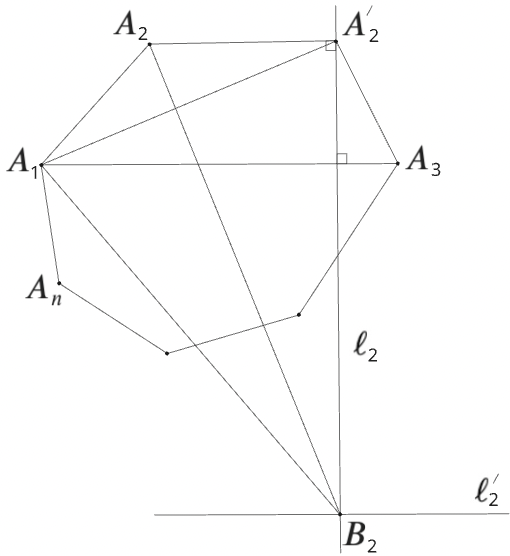
where AiAi+1=ai (indices mod n), and B2=ℓ2∩ℓ2′, lines ℓ2 and ℓ2′ are defined:
ℓ2: the line perpendicular to A1A3 passing through the point (x0,0), where
x0=2aa2−a32+a42−⋯+(−1)nan2
and a=A1A3, we take A1=(0,0), A3=(a,0).
ℓ2′: the line parallel to A1A3 passing through the point (0,y0), where
y0=a2((A1A2A3)−(A1A2…An))
lying on the side of A1A3 opposite to A2, and a=A1A3.
Important (constructing the point B2). Looking at the form of y0 in the previous equation, it initially appears that the area of (A1A2…An) is required to construct line ℓ2′ and, consequently, to locate point B2. This seems to introduce a circular argument, implying that we must already know the area of (A1A2…An) to find it. However, in Remark 1 of the next section, we demonstrate that the value of this area is not actually needed to construct ℓ2′ and determine the location of B2.
The meaning of the formula
At first glance, the introduction of the point B2 may seem somewhat unusual. However, consider the analogous concept of the center of mass of a three-dimensional body. The center of mass is a single point that represents the distribution of mass throughout the body, and it is well known that this point may lie outside the body itself. In two dimensions, instead of volume, we consider area. The concept of volume in three dimensions corresponds to the concept of area in two dimensions. In a similar way, the point B2 can be viewed as a representative point associated with the area distribution of the figure.
The proof of the main result
Let us denote the area of a convex n-gon A1A2…An by (A1A2…An). Let A1A2=a1, A2A3=a2, ..., An−1An=an−1, AnA1=an.
Problem 1. Find the locus of all points M in the plane such that
MA32−MA12=a32−a42+⋯+(−1)n−1an2.
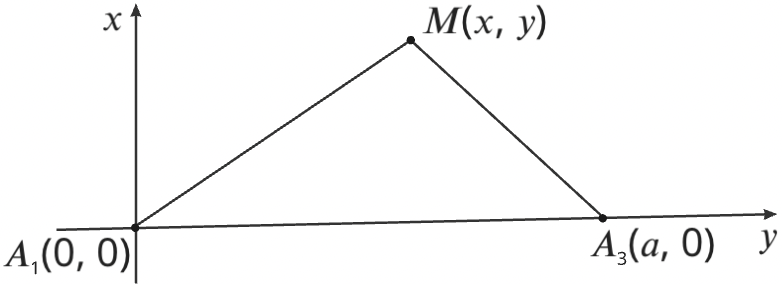
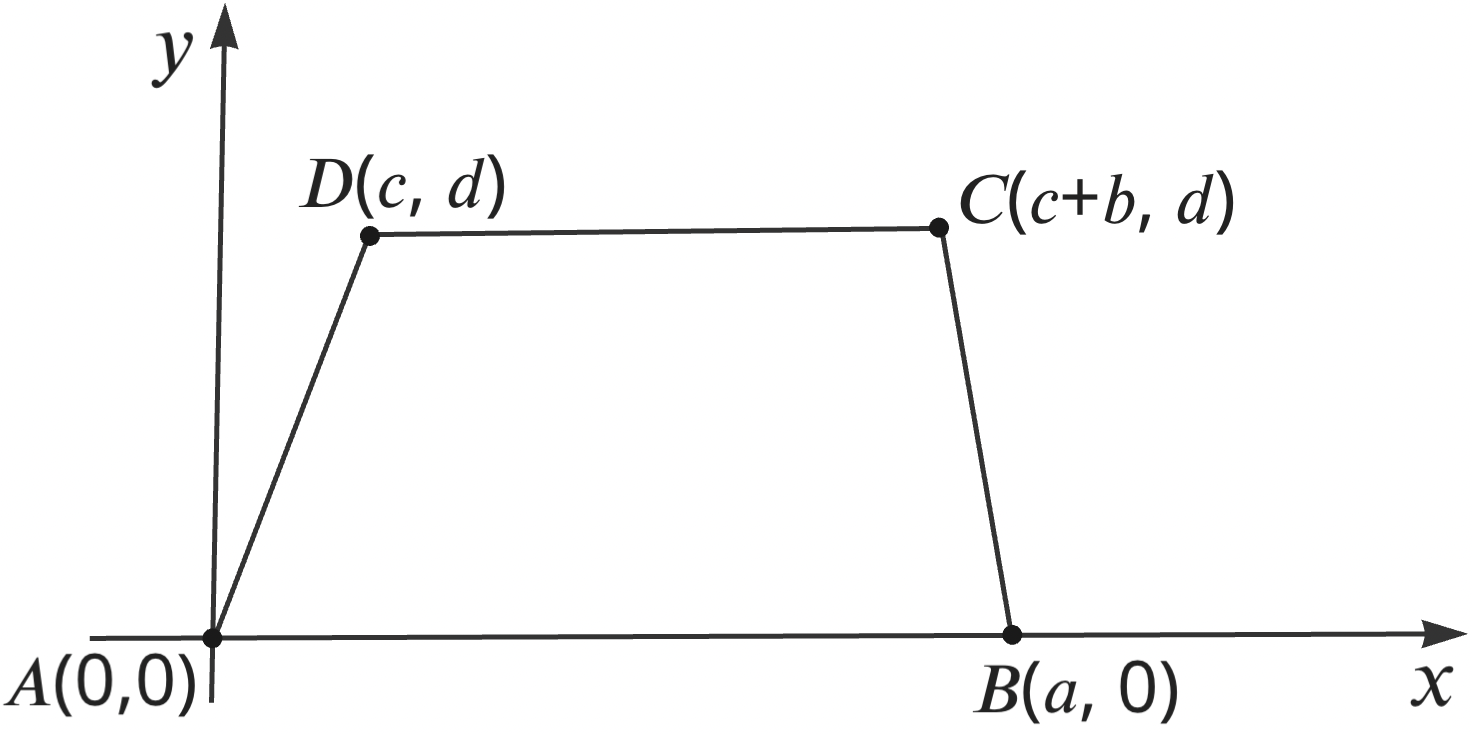
Solution of Problem 1. Choose a coordinate system as shown in the figure.
We have
MA32−MA12=a32−a42+⋯+(−1)n−1an2.
Thus
(x−a)2+y2−x2−y2=a32−a42+⋯+(−1)n−1an2.
x=2aa2−a32+⋯+(−1)nan2.
Let us prove that the locus of all points M in the plane is line l2 which passes through the point
(2aa2−a32+⋯+(−1)nan2,0)
and is perpendicular to line A1A3.
If n=3, then a=a3 and line l2 passes through the point A1(0,0). If n=4, then line l2 is passing through point A4, as
A4A32−A4A12=a32−a42.
Problem 2. Find the locus of all points M in the plane such that (MA1A2A3)=(A1A2…An) and that points M and A2 are not on the same side of line A1A3.
Solution of Problem 2. Choose a coordinate system as shown in the solution to problem 1. Let M(x,y), where y≤0, we have
Let us prove that the locus of all points M is line l2′ passing through point
(0,a2((A1A2A3)−(A1A2…An)))
and is perpendicular to line l2.
If n=3, then line l2′ coincides with line A1A3, as
a2((A1A2A3)−(A1A2…An))=0.
If n=4, then line l2′ passes through point A4, as
a2((A1A2A3)−(A1A2A3A4))=−a2(A1A4A3).
Let us denote by B2 the intersection point of lines l2 and l2′, in a similar way denote by Bi the intersection point of lines li and li′, where i=1,…,n.
If n≥5, then let us start with the following remark.
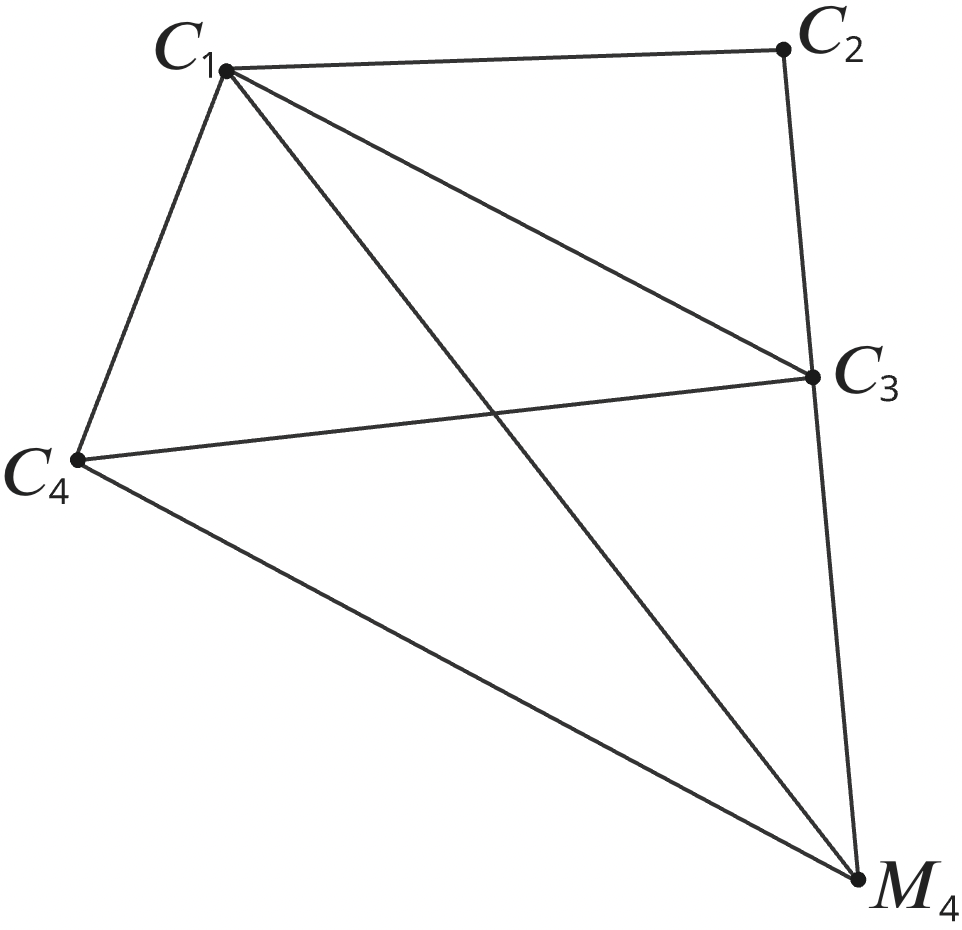
Remark 1. Let a convex n-gon be given. Construct point Mn on line C2C3 such that
(MnC1C2)=(C1C2…Cn).
Let us construct point Mn be mathematical induction.
The base case. If n=4, then from point C4 let us draw a line parallel to line C1C3. Denote by M4 the intersection point of that line and ray C2C3 (see figure).
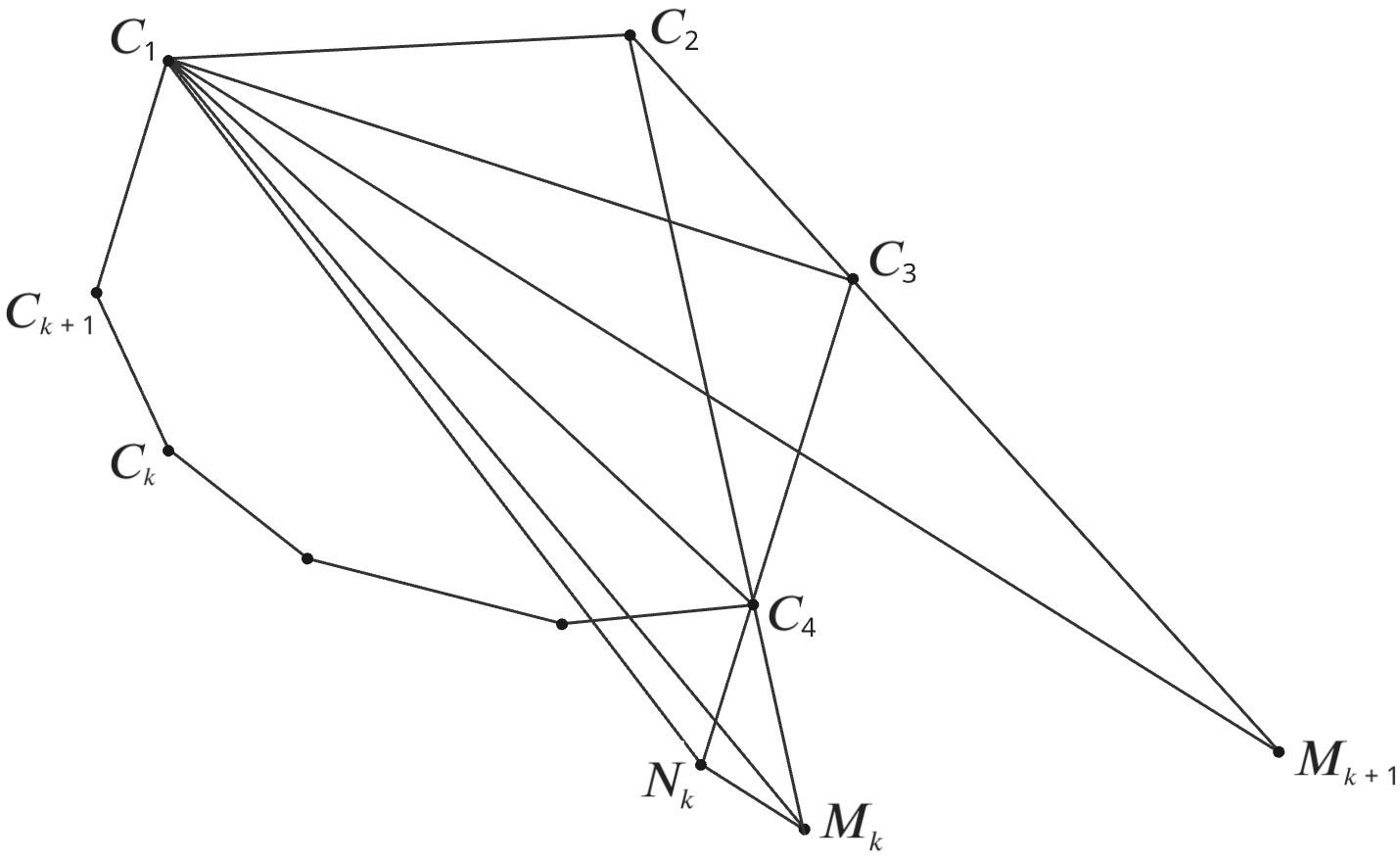
The inductive hypothesis. Assume that for n=k the point Mk is already constructed, then let us show how point Mk+1 is constructed. Consider the convex polygon C1C2C4…Ck+1. According to the inductive hypothesis on ray C2C4 we can construct point Mk such that
(MkC1C2)=(C1C2C4…Ck+1).
Let us draw a line from point Mk parallel to line C1C4 (see figure). Denote by Nk the intersection point of that line and line C3C4.
It is left for quadrilateral C1C2C3Nk on ray C2C3 to construct point Mk+1, such that
(Mk+1C1C2)=(C1C2C3Nk)
(2)
From (1) and (2), we get
(Mk+1C1C2)=(C1C2C3…Ck+1).
This ends the proof for n=k+1. Thus, this ends the proof for any n≥4.
To construct line l2′ it is sufficient to construct point Mn−1 for the polygon A1A3A4…A4 and to draw a line passing through point Mn−1 and parallel to line A1A3.
Let us prove the following theorem.
Theorem. The area of a convex n-gon A1A2…An is:
414A1A32⋅A2B22−(a12−a22+⋯+(−1)n−1an2)2.
To prove this theorem, we use the following lemma.
Lemma (the Trapezoid Law [Sedrakyan et al.], see [1], chapter 5). Let sides AB and CD of quadrilateral ABCD be parallel to each other, then
2⋅AB⋅CD=AC2+BD2−AD2−BC2.
Let us continue the proof of the theorem, consider the the following figure.
Conclusion. Triangles (n=3) are inherently rigid because fixing their side lengths completely locks their interior angles and area into place. Quadrilaterals, pentagons, and higher-order polygons (n≥4) are flexible, meaning their sides can deform and flex like a mechanical linkage, constantly changing their angles and overall area. This fundamental fluidness is why a unified, side-length-based area formula was long considered impossible for shapes with five or more sides. Conversely, in geometry, you cannot find the area of an irregular n-gon purely from its sides because the shape can bend. By capturing that exact architectural fluidness inside a single point B2 and an alternating sum of squared sides, this area formula accomplishes something structurally revolutionary that did not have an existing. It proves that the chaotic flexibility of any arbitrary polygon can be structurally bound and unified under a single algebraic law, opening the door to solving distance-only constraints that were previously considered mathematically impossible.
Example showing how the formula works
Example. Let us find the area of a regular hexagon A1A2…A6, where A1A2=1.
Solution. Line l2 is determined by all points M satisfying the following equation
MA32−MA12=a32−a42+a52−a62=0.
So, it will be the perpendicular bisector of line segment A1A3 (see figure).
Now, let us construct line l2′ and find the intersection point B2 of lines l2 and l2′. Using the theorem we have that l2′ is parrallel to A1A3 and is passing through the point (0,y0), where
Verification of the answer. A regular hexagon with side length 1 can be divided into six equilateral triangles of side length 1. The area of one equilateral triangle with side length 1 is
A△=43.
Therefore, the area of the hexagon is
(A1A2A3A4A5A6)=6⋅43=233.
Applications
Application 1. A triangle has side lengths 3, 5, and 7. Find its area.
Application 2. Consider a trapezoid with bases of lengths 5 and 9. If the sum of the squares of its diagonals is 196, find the sum of the squares of its legs.
Application 3. The area of triangle with sides a, b, c is equal to the area of triangle with sides a, b, d, where d=c, and that a2+b2=16, find c2+d2.
Application 4. Each of two non-congruent triangles has two sides of lengths 5 and 7, and the triangles have equal circumradii. Find the product of the lengths of their third sides.
Application 5. Let a1, a2, a3 be the side lengths of a triangle, prove that
Application 2. Consider a trapezoid with bases of lengths 5 and 9. If the sum of the squares of its diagonals is 196, find the sum of the squares of its legs.
Solution. Let the diagonals be e and f (see the figure). Given that e2+f2=196. It is a known result that if e2+f2=(a+b)2, where a and b are the bases then this condition is equivalent to the condition that the diagonals of the trapezoid must be perpendicular to each other. In this case the bases are 5 and 9, given that e2+f2=196=(5+9)2. This means that the diagonals of this trapezoid must be perpendicular to each other. Then, we have
Area of trapezoid=2e⋅f.
On the other hand (by the considered area formula), we have
Area of trapezoid=414e2f2−(a2−52+c2−92)2.
Thus, we get
2ef=414e2f2−(a2−52+c2−92)2.
Squaring both side of this equation, we get
4e2f2=161(4e2f2−(a2−52+c2−92)2).
This means that
(a2−52+c2−92)2=0.
So, we get
a2+c2=52+92=106.
Application 3. The area of triangle with sides a, b, c is equal to the area of triangle with sides a, b, d, where d=c, and that a2+b2=16, find c2+d2.
Solution. As the areas of both triangles are equal, then we have
414a2b2−(a2+b2−c2)2=414a2b2−(a2+b2−d2)2.
Squaring both sides and canceling the expression 4a2b2 on both side, we get
(a2+b2−c2)2=(a2+b2−d2)2.
Therefore,
(a2+b2−c2)2−(a2+b2−d2)2=0.
Note that this can be factored as follows:
(a2+b2−c2−(a2+b2−d2))⋅(a2+b2−c2+(a2+b2−d2))=0.
Simplifying, we get
(c2−d2)⋅(2(a2+b2)−(c2+d2))=0.
Given that a2+b2=16, hence
(c2−d2)⋅(2⋅16−(c2+d2))=0.
Given also that c=d, thus c2−d2=0. Therefore,
32−(c2+d2)=0.
We obtain
c2+d2=32.
Application 4. Each of two non-congruent triangles has two sides of lengths 5 and 7, and the triangles have equal circumradii. Find the product of the lengths of their third sides.
Solution of Application 3. Denote their areas by A1 and A2, denote the length of their third sides by a and b, then by this area formula, we have
A1=414⋅52⋅72−(52−a2+72)2,
A2=414⋅52⋅72−(52−b2+72)2.
Denote by R1 and R2 their circumradii, then by the law of sines, we have
A1=4R15⋅7a,
A2=4R25⋅7b.
As R1=R2, we get
4A15⋅7a=4A25⋅7b.
Thus, it follows that
4⋅52⋅72−(52−a2+72)2a=4⋅52⋅72−(52−b2+72)2b.
Squaring both sides, we get
a2(4⋅52⋅72−(52−b2+72)2)=b2(4⋅52⋅72−(52−a2+72)2).
Simplifying and using difference of squares formula, we get
Bretschneider, C. A., Untersuchung der trigonometrischen Relationen des geradlinigen Viereckes. Archiv der Math. 2, 225–261, 1842.
Coolidge, J. L., A Historically Interesting Formula for the Area of a Quadrilateral. Amer. Math. Monthly 46, 345–347, 1939.
Heath, T. L., A History of Greek Mathematics, Vol. 2. Clarendon Press, 1921.
Sedrakyan, H., Sedrakyan, N., Algebraic Inequalities. Springer International Publishing, 2018.
Sedrakyan, H., Sedrakyan, N., Mathematics Competitions Must-Know Geometry: Practice and Theory Inspired by the Style of AMC and AIME Geometry (Unofficial Guide). 2023.