Download the full paper (PDF)
Abstract In 1997, Nairi Sedrakyan published an article titled About the Applications of One Useful Inequality , in which he proved the inequality for squares and for k th k^{\text{th}} k th Nairi Sedrakyan was the first author to publish the inequality for k th k^{\text{th}} k th Hayk Sedrakyan and Nairi Sedrakyan later republished the generalizations for k th k^{\text{th}} k th Algebraic Inequalities (published by Springer ). The inequality for squares was published by several authors and became popular under the name Sedrakyan's inequality (1997), or Titu's lemma (2003), refering to T. Andreescu's 2003 book Mathematical Olympiad Treasures . The inequality for squares is also known as Engel's form or Bergström's inequality . Sedrakyan's inequality is a special case and a consequence of the Cauchy–Schwarz inequality . It is universally recognized as one of the most important and widely used inequalities in all of mathematics.
Introduction Generalization of Sedrakyan's inequality for the kth power (n terms).
Let a 1 , a 2 , … , a n > 0 a_1,a_2,\ldots,a_n>0 a 1 , a 2 , … , a n > 0 b 1 , b 2 , … , b n > 0 b_1,b_2,\ldots,b_n>0 b 1 , b 2 , … , b n > 0 c 1 , c 2 , … , c n > 0 c_1,c_2,\ldots,c_n>0 c 1 , c 2 , … , c n > 0 … \ldots … γ 1 , γ 2 , … , γ n > 0 \gamma_{1},\gamma_{2},\ldots,\gamma_{n}>0 γ 1 , γ 2 , … , γ n > 0
a 1 k b 1 c 1 ⋯ γ 1 ⏟ k − 1 terms + a 2 k b 2 c 2 ⋯ γ 2 ⏟ k − 1 terms + ⋯ + a n k b n c n ⋯ γ n ⏟ k − 1 terms ≥ ( a 1 + a 2 + ⋯ + a n ) k ( b 1 + b 2 + ⋯ + b n ) ( c 1 + c 2 + ⋯ + c n ) ⋯ ( γ 1 + γ 2 + ⋯ + γ n ) \frac{a_{1}^{k}}{\underbrace{b_1 c_1 \cdots \gamma_{1}}_{k-1\text{ terms}}}+\frac{a_{2}^{k}}{\underbrace{b_2 c_2 \cdots \gamma_{2}}_{k-1\text{ terms}}}+\cdots+\frac{a_{n}^{k}}{\underbrace{b_n c_n \cdots \gamma_{n}}_{k-1\text{ terms}}}\ge\frac{(a_1+a_2+\cdots+a_n)^k}{(b_1+b_2+\cdots+b_n)(c_1+c_2+\cdots+c_n)\cdots(\gamma_{1}+\gamma_{2}+\cdots+\gamma_{n})} k − 1 terms b 1 c 1 ⋯ γ 1 a 1 k + k − 1 terms b 2 c 2 ⋯ γ 2 a 2 k + ⋯ + k − 1 terms b n c n ⋯ γ n a n k ≥ ( b 1 + b 2 + ⋯ + b n ) ( c 1 + c 2 + ⋯ + c n ) ⋯ ( γ 1 + γ 2 + ⋯ + γ n ) ( a 1 + a 2 + ⋯ + a n ) k In the section Equality conditions , we provide the equality conditions.
Generalization of Sedrakyan's inequality for cubes (n terms).
Let a 1 , a 2 , … , a n > 0 a_1,a_2,\ldots,a_n>0 a 1 , a 2 , … , a n > 0 b 1 , b 2 , … , b n > 0 b_1,b_2,\ldots,b_n>0 b 1 , b 2 , … , b n > 0 c 1 , c 2 , … , c n > 0 c_1,c_2,\ldots,c_n>0 c 1 , c 2 , … , c n > 0
a 1 3 b 1 c 1 + a 2 3 b 2 c 2 + a 3 3 b 3 c 3 + ⋯ + a n 3 b n c n ≥ ( a 1 + a 2 + ⋯ + a n ) 3 ( b 1 + b 2 + ⋯ + b n ) ( c 1 + c 2 + ⋯ + c n ) \frac{a_{1}^{3}}{b_1 c_1}+\frac{a_{2}^{3}}{b_2 c_2}+\frac{a_{3}^{3}}{b_3 c_3}+\cdots+\frac{a_{n}^{3}}{b_n c_n}\ge\frac{(a_1+a_2+\cdots+a_n)^3}{(b_1+b_2+\cdots+b_n)(c_1+c_2+\cdots+c_n)} b 1 c 1 a 1 3 + b 2 c 2 a 2 3 + b 3 c 3 a 3 3 + ⋯ + b n c n a n 3 ≥ ( b 1 + b 2 + ⋯ + b n ) ( c 1 + c 2 + ⋯ + c n ) ( a 1 + a 2 + ⋯ + a n ) 3 In the section Equality conditions , we provide the equality conditions.
Sedrakyan's inequality (Titu's lemma).
Let a 1 , a 2 , … , a n a_1,a_2,\ldots,a_n a 1 , a 2 , … , a n b 1 , b 2 , … , b n > 0 b_1,b_2,\ldots,b_n>0 b 1 , b 2 , … , b n > 0
a 1 2 b 1 + a 2 2 b 2 + ⋯ + a n 2 b n ≥ ( a 1 + a 2 + ⋯ + a n ) 2 b 1 + b 2 + ⋯ + b n \frac{a_{1}^{2}}{b_{1}}+\frac{a_{2}^{2}}{b_{2}}+\cdots+\frac{a_{n}^{2}}{b_{n}}\ge\frac{(a_{1}+a_{2}+\cdots+a_{n})^{2}}{b_{1}+b_{2}+\cdots+b_{n}} b 1 a 1 2 + b 2 a 2 2 + ⋯ + b n a n 2 ≥ b 1 + b 2 + ⋯ + b n ( a 1 + a 2 + ⋯ + a n ) 2 Equality conditions The first equality condition is the one for the k th k^{\text{th}} k th
Generalization for the kth power (n terms), equality condition.
{ a 1 b 1 = a 2 b 2 = a 3 b 3 = ⋯ = a n b n , b 1 c 1 = b 2 c 2 = b 3 c 3 = ⋯ = b n c n , ⋮ y 1 γ 1 = y 2 γ 2 = y 3 γ 3 = ⋯ = y n γ n . \left\{\begin{array}{l}\dfrac{a_1}{b_1} = \dfrac{a_2}{b_2} = \dfrac{a_3}{b_3} = \cdots = \dfrac{a_n}{b_n},\\[10pt]\dfrac{b_1}{c_1} = \dfrac{b_2}{c_2} = \dfrac{b_3}{c_3} = \cdots = \dfrac{b_n}{c_n},\\[10pt]\vdots \\[10pt]\dfrac{y_1}{\gamma_{1}} = \dfrac{y_2}{\gamma_{2}} = \dfrac{y_3}{\gamma_{3}} = \cdots = \dfrac{y_n}{\gamma_{n}}.\end{array}\right. ⎩ ⎨ ⎧ b 1 a 1 = b 2 a 2 = b 3 a 3 = ⋯ = b n a n , c 1 b 1 = c 2 b 2 = c 3 b 3 = ⋯ = c n b n , ⋮ γ 1 y 1 = γ 2 y 2 = γ 3 y 3 = ⋯ = γ n y n . The next one is the generalization for cubes with n n n
Generalization for cubes (n terms), equality condition.
{ a 1 b 1 = a 2 b 2 = a 3 b 3 = . . . = a n − 1 b n − 1 , b 1 c 1 = b 2 c 2 = b 3 c 3 = . . . = b n − 1 c n − 1 . \begin{cases}\dfrac{a_1}{b_1}=\dfrac{a_2}{b_2}=\dfrac{a_3}{b_3}=...=\dfrac{a_{n-1}}{b_{n-1}}, \\[8pt] \dfrac{b_1}{c_1}=\dfrac{b_2}{c_2}=\dfrac{b_3}{c_3}=...=\dfrac{b_{n-1}}{c_{n-1}}.\end{cases} ⎩ ⎨ ⎧ b 1 a 1 = b 2 a 2 = b 3 a 3 = ... = b n − 1 a n − 1 , c 1 b 1 = c 2 b 2 = c 3 b 3 = ... = c n − 1 b n − 1 . The third one is Sedrakyan's inequality's (Titu's lemma) equality condition.
Sedrakyan's inequality (Titu's lemma), equality condition.
a 1 b 1 = a 2 b 2 = a 3 b 3 = ⋯ = a n b n . \frac{a_1}{b_1}=\frac{a_2}{b_2}=\frac{a_3}{b_3}=\cdots=\frac{a_n}{b_n}. b 1 a 1 = b 2 a 2 = b 3 a 3 = ⋯ = b n a n . Proofs of the initial inequality In this section we provide the proof of Sedrakyan's inequality (Titu's lemma). In the next section (Main Results and Proofs) we provide the proofs of the generalizations and their corresponding equality conditions.
Proof. At first, we want to prove the following.
Sedrakyan's inequality (Titu's lemma).
Let a 1 , a 2 , … , a n a_1,a_2,\ldots,a_n a 1 , a 2 , … , a n b 1 , b 2 , … , b n > 0 b_1,b_2,\ldots,b_n>0 b 1 , b 2 , … , b n > 0
a 1 2 b 1 + a 2 2 b 2 + ⋯ + a n 2 b n ≥ ( a 1 + a 2 + ⋯ + a n ) 2 b 1 + b 2 + ⋯ + b n \frac{a_{1}^{2}}{b_{1}}+\frac{a_{2}^{2}}{b_{2}}+\cdots+\frac{a_{n}^{2}}{b_{n}}\ge\frac{(a_{1}+a_{2}+\cdots+a_{n})^{2}}{b_{1}+b_{2}+\cdots+b_{n}} b 1 a 1 2 + b 2 a 2 2 + ⋯ + b n a n 2 ≥ b 1 + b 2 + ⋯ + b n ( a 1 + a 2 + ⋯ + a n ) 2 In order to prove this inequality let us start with the case of two terms, that is: let a > 0 a > 0 a > 0 b > 0 b > 0 b > 0
x 2 a + y 2 b ≥ ( x + y ) 2 a + b . \boxed{\frac{x^2}{a} + \frac{y^2}{b} \geq \frac{(x+y)^2}{a+b}.} a x 2 + b y 2 ≥ a + b ( x + y ) 2 . Rewrite this expression using a common denominator:
x 2 b + y 2 a a b ≥ ( x + y ) 2 a + b . \frac{x^2b+y^2a}{ab} \geq \frac{(x+y)^2}{a+b}. ab x 2 b + y 2 a ≥ a + b ( x + y ) 2 . Cross multiply to get:
x 2 b a + y 2 a 2 + x 2 b 2 + y 2 a b ≥ x 2 a b + 2 x y a b + y 2 a b . x^2ba+y^2a^2+x^2b^2+y^2ab \geq x^2ab+2xyab+y^2ab. x 2 ba + y 2 a 2 + x 2 b 2 + y 2 ab ≥ x 2 ab + 2 x y ab + y 2 ab . Then, cancel the common terms:
y 2 a 2 + x 2 b 2 ≥ 2 x y a b . y^2a^2+x^2b^2 \geq 2xyab. y 2 a 2 + x 2 b 2 ≥ 2 x y ab . Let us rewrite it this way:
y 2 a 2 − 2 x y a b + x 2 b 2 ≥ 0. y^2a^2-2xyab+x^2b^2 \geq 0. y 2 a 2 − 2 x y ab + x 2 b 2 ≥ 0. Complete the square:
( y a − x b ) 2 ≥ 0. (ya-xb)^2 \geq 0. ( y a − x b ) 2 ≥ 0. As a square of any number is non-negative, this ends the proof of the initial statement.
Using the case of two terms, let us prove the same statement for three terms, that is:
x 2 a + y 2 b + z 2 c ≥ ( x + y + z ) 2 a + b + c . \boxed{\frac{x^2}{a} + \frac{y^2}{b} + \frac{z^2}{c}\geq \dfrac{(x+y+z)^{2}}{a + b + c}.} a x 2 + b y 2 + c z 2 ≥ a + b + c ( x + y + z ) 2 . Denote x + y = A x+y=A x + y = A a + b = B a+b=B a + b = B
( x + y ) 2 a + b + z 2 c = A 2 B + z 2 c ≥ ( A + z ) 2 B + c = ( ( x + y ) + z ) 2 ( a + b ) + c . \frac{(x+y)^2}{a+b}+\frac{z^2}{c} = \frac{A^{2}}{B} + \frac{z^2}{c} \geq \frac{(A+z)^2}{B+c} = \dfrac{((x+y) + z)^{2}}{(a+b)+c}. a + b ( x + y ) 2 + c z 2 = B A 2 + c z 2 ≥ B + c ( A + z ) 2 = ( a + b ) + c (( x + y ) + z ) 2 . Thus, it follows that
x 2 a + y 2 b + z 2 c ≥ ( x + y ) 2 a + b + z 2 c ≥ ( ( x + y ) + z ) 2 ( a + b ) + c = ( x + y + z ) 2 a + b + c . \frac{x^2}{a} + \frac{y^2}{b} + \frac{z^2}{c}\geq \frac{(x+y)^2}{a+b}+\frac{z^2}{c} \geq \dfrac{((x+y) + z)^{2}}{(a+b)+c} = \dfrac{(x + y + z)^{2}}{a+b+c}. a x 2 + b y 2 + c z 2 ≥ a + b ( x + y ) 2 + c z 2 ≥ ( a + b ) + c (( x + y ) + z ) 2 = a + b + c ( x + y + z ) 2 . This ends the proof of the statement for three terms.
In a similar way, we can prove the case of four terms, and have the same result with more terms like 5, 6, 7,... (up to n n n n n n
This ends the proof of Sedrakyan's inequality (Titu's lemma).
Equality condition for two terms (second power). Let us prove the equality is possible (for two terms):
x 2 a + y 2 b = ( x + y ) 2 a + b . \frac{x^2}{a} + \frac{y^2}{b} =\frac{(x+y)^2}{a+b}. a x 2 + b y 2 = a + b ( x + y ) 2 . Rewrite with common denominator
x 2 b + y 2 a a b = ( x + y ) 2 a + b . \frac{x^2b+y^2a}{ab} = \frac{(x+y)^2}{a+b}. ab x 2 b + y 2 a = a + b ( x + y ) 2 . Cross multiply
x 2 b a + y 2 a 2 + x 2 b 2 + y 2 a b = x 2 a b + 2 x y a b + y 2 a b . x^2ba+y^2a^2+x^2b^2+y^2ab = x^2ab+2xyab+y^2ab. x 2 ba + y 2 a 2 + x 2 b 2 + y 2 ab = x 2 ab + 2 x y ab + y 2 ab . Cancel common terms
y 2 a 2 + x 2 b 2 = 2 x y a b . y^2a^2+x^2b^2=2xyab. y 2 a 2 + x 2 b 2 = 2 x y ab . ( y a − x b ) 2 = 0. (ya-xb)^2=0. ( y a − x b ) 2 = 0. This is true when y a = x b ya=xb y a = x b
x y = a b . \boxed{\dfrac{x}{y} = \dfrac{a}{b}.} y x = b a . Equality condition for three terms (second power). Let us prove the equality is possible (for three terms):
x 2 a + y 2 b + z 2 c = ( x + y + z ) 2 a + b + c . \frac{x^2}{a} + \frac{y^2}{b} + \frac{z^2}{c}= \dfrac{(x + y + z)^{2}}{a+b+c}. a x 2 + b y 2 + c z 2 = a + b + c ( x + y + z ) 2 . For the equality condition we have
x a = y b . \frac{x}{a}=\frac{y}{b}. a x = b y . In a similar way, we have that
x + y a + b = z c . \frac{x+y}{a+b}=\frac{z}{c}. a + b x + y = c z . Denote
x a = y b = k . \frac{x}{a}=\frac{y}{b}=k. a x = b y = k . Then
and
Plug-in to get that
k a + k b a + b = z c . \frac{ka+kb}{a+b}=\frac{z}{c}. a + b k a + k b = c z . We obtain
k ( a + b ) a + b = z c . \frac{k(a+b)}{a+b}=\frac{z}{c}. a + b k ( a + b ) = c z . Hence
k = z c . k=\frac{z}{c}. k = c z . Thus, it follows that the equality condition is:
x a = y b = z c . \boxed{\frac{x}{a}=\frac{y}{b}= \frac{z}{c}.} a x = b y = c z . Equality condition for n-terms (second power). In a similar way, we can get the inequality condition for 4, 5, 6, 7,... terms until n n n n n n
a 1 b 1 = a 2 b 2 = a 3 b 3 = . . . = a n b n . \boxed{\frac{a_1}{b_1} = \frac{a_2}{b_2} = \frac{a_3}{b_3} = ... = \frac{a_n}{b_n}.} b 1 a 1 = b 2 a 2 = b 3 a 3 = ... = b n a n . Main results and proofs Generalization for cubes. Let b 1 b_{1} b 1 b 2 b_{2} b 2 c 1 c_{1} c 1 c 2 c_{2} c 2
a 1 3 b 1 ⋅ c 1 + a 2 3 b 2 ⋅ c 2 ≥ ( a 1 + a 2 ) 3 ( b 1 + b 2 ) ( c 1 + c 2 ) . \boxed{\frac{a_{1}^{3}}{b_1 \cdot c_1}+\frac{a_{2}^{3}}{b_2\cdot c_2}\geq \frac{(a_1+a_2)^3}{(b_1+b_2)(c_1+c_2)}.} b 1 ⋅ c 1 a 1 3 + b 2 ⋅ c 2 a 2 3 ≥ ( b 1 + b 2 ) ( c 1 + c 2 ) ( a 1 + a 2 ) 3 . Proof. Rewrite it using the common denominator and opening the paranthesis:
b 2 c 2 a 1 3 + b 1 c 1 a 2 2 b 1 b 2 c 1 c 2 ≥ a 1 3 + 3 a 1 2 a 2 + 3 a 1 a 2 2 + a 2 3 c 1 b 1 + c 1 b 2 + c 2 b 1 + c 2 b 2 . \frac{b_2c_2a_1^3+b_1c_1a_2^2}{b_1b_2c_1c_2}\geq\frac{a_1^3+3a_1^2a_2+3a_1a_2^2+a_2^3}{c_1b_1+c_1b_2+c_2b_1+c_2b_2}. b 1 b 2 c 1 c 2 b 2 c 2 a 1 3 + b 1 c 1 a 2 2 ≥ c 1 b 1 + c 1 b 2 + c 2 b 1 + c 2 b 2 a 1 3 + 3 a 1 2 a 2 + 3 a 1 a 2 2 + a 2 3 . Cross-multiply to get
a 1 3 b 1 c 1 b 2 c 2 + a 1 3 b 2 2 c 1 c 2 + a 1 3 c 2 2 b 1 b 2 + a 1 3 b 2 2 c 2 2 + a 2 3 b 1 2 c 1 2 + a 2 3 c 1 2 b 1 b 2 + a 2 3 b 1 2 c 1 c 2 + a_1^3b_1c_1b_2c_2+a_1^3b_2^2c_1c_2+a_1^3c_2^2b_1b_2+a_1^3b_2^2c_2^2+a_2^3b_1^2c_1^2+a_2^3c_1^2b_1b_2+a_2^3b_1^2c_1c_2+ a 1 3 b 1 c 1 b 2 c 2 + a 1 3 b 2 2 c 1 c 2 + a 1 3 c 2 2 b 1 b 2 + a 1 3 b 2 2 c 2 2 + a 2 3 b 1 2 c 1 2 + a 2 3 c 1 2 b 1 b 2 + a 2 3 b 1 2 c 1 c 2 + + a 2 3 b 1 c 1 b 2 c 2 ≥ a 1 3 b 1 c 1 b 2 c 2 + 3 a 1 2 a 2 b 1 b 2 c 1 c 2 + 3 a 1 a 2 2 b 1 b 2 c 1 c 2 + a 2 3 b 1 c 1 b 2 c 2 . +a_2^3b_1c_1b_2c_2 \geq a_1^3b_1c_1b_2c_2 + 3a_1^2a_2b_1b_2c_1c_2+3a_1a_2^2b_1b_2c_1c_2+a_2^3b_1c_1b_2c_2. + a 2 3 b 1 c 1 b 2 c 2 ≥ a 1 3 b 1 c 1 b 2 c 2 + 3 a 1 2 a 2 b 1 b 2 c 1 c 2 + 3 a 1 a 2 2 b 1 b 2 c 1 c 2 + a 2 3 b 1 c 1 b 2 c 2 . Cancel the like terms to obtain
a 1 3 b 2 2 c 1 c 2 + a 1 3 c 2 2 b 1 b 2 + a 1 3 b 2 2 c 2 2 + a 2 3 b 1 2 c 1 2 + a 2 3 c 1 2 b 1 b 2 + a 2 3 b 1 2 c 1 c 2 ≥ 3 a 1 2 a 2 b 1 b 2 c 1 c 2 + 3 a 1 a 2 2 b 1 b 2 c 1 c 2 . a_1^3b_2^2c_1c_2+a_1^3c_2^2b_1b_2+a_1^3b_2^2c_2^2+a_2^3b_1^2c_1^2+a_2^3c_1^2b_1b_2+a_2^3b_1^2c_1c_2\geq 3a_1^2a_2b_1b_2c_1c_2+3a_1a_2^2b_1b_2c_1c_2. a 1 3 b 2 2 c 1 c 2 + a 1 3 c 2 2 b 1 b 2 + a 1 3 b 2 2 c 2 2 + a 2 3 b 1 2 c 1 2 + a 2 3 c 1 2 b 1 b 2 + a 2 3 b 1 2 c 1 c 2 ≥ 3 a 1 2 a 2 b 1 b 2 c 1 c 2 + 3 a 1 a 2 2 b 1 b 2 c 1 c 2 . We apply the inequality A + B + C ≥ 3 A B C 3 A+B+C\geq 3\sqrt[3]{ABC} A + B + C ≥ 3 3 A B C
a 1 3 b 2 2 c 1 c 2 + a 1 3 c 2 2 b 1 b 2 + a 2 3 b 1 2 c 1 2 ≥ 3 a 1 3 b 2 2 c 1 c 2 ⋅ a 1 3 c 2 2 b 1 b 2 ⋅ a 2 3 b 1 2 c 1 2 3 = 3 ⋅ a 1 2 a 2 b 1 b 2 c 1 c 2 . a_1^3b_2^2c_1c_2+ a_1^3c_2^2b_1b_2+ a_2^3b_1^2c_1^2 \geq 3\sqrt[3]{a_1^3b_2^2c_1c_2\cdot a_1^3c_2^2b_1b_2\cdot a_2^3b_1^2c_1^2} = 3 \cdot a_1^2a_2b_1b_2c_1c_2. a 1 3 b 2 2 c 1 c 2 + a 1 3 c 2 2 b 1 b 2 + a 2 3 b 1 2 c 1 2 ≥ 3 3 a 1 3 b 2 2 c 1 c 2 ⋅ a 1 3 c 2 2 b 1 b 2 ⋅ a 2 3 b 1 2 c 1 2 = 3 ⋅ a 1 2 a 2 b 1 b 2 c 1 c 2 . a 1 3 b 2 2 c 2 2 + a 2 3 c 1 2 b 1 b 2 + a 2 3 b 1 2 c 1 c 2 ≥ 3 a 1 3 b 2 2 c 2 2 ⋅ a 2 3 c 1 2 b 1 b 2 ⋅ a 2 3 b 1 2 c 1 c 2 3 = 3 ⋅ a 2 2 a 1 b 1 b 2 c 1 c 2 . a_1^3b_2^2c_2^2 + a_2^3c_1^2b_1b_2 + a_2^3b_1^2c_1c_2 \geq 3\sqrt[3]{a_1^3b_2^2c_2^2 \cdot a_2^3c_1^2b_1b_2 \cdot a_2^3b_1^2c_1c_2} = 3 \cdot a_2^2a_1b_1b_2c_1c_2. a 1 3 b 2 2 c 2 2 + a 2 3 c 1 2 b 1 b 2 + a 2 3 b 1 2 c 1 c 2 ≥ 3 3 a 1 3 b 2 2 c 2 2 ⋅ a 2 3 c 1 2 b 1 b 2 ⋅ a 2 3 b 1 2 c 1 c 2 = 3 ⋅ a 2 2 a 1 b 1 b 2 c 1 c 2 . Summing up the last two inequalities ends the proof (for cubes with two terms).
Equality condition for two terms (third power). It is known that in the inequality
A + B + C ≥ 3 A B C 3 , A+B+C\geq 3\sqrt[3]{ABC}, A + B + C ≥ 3 3 A B C , the equality holds true when A = B = C A = B = C A = B = C
a 1 3 b 2 2 c 2 2 = a 2 3 c 1 2 b 1 b 2 = a 2 3 b 1 2 c 1 c 2 , a_1^3b_2^2c_2^2 = a_2^3c_1^2b_1b_2 = a_2^3b_1^2c_1c_2, a 1 3 b 2 2 c 2 2 = a 2 3 c 1 2 b 1 b 2 = a 2 3 b 1 2 c 1 c 2 , and
a 1 3 b 2 2 c 2 2 = a 2 3 c 1 2 b 1 b 2 = a 2 3 b 1 2 c 1 c 2 . a_1^3b_2^2c_2^2 = a_2^3c_1^2b_1b_2 = a_2^3b_1^2c_1c_2. a 1 3 b 2 2 c 2 2 = a 2 3 c 1 2 b 1 b 2 = a 2 3 b 1 2 c 1 c 2 . Now, let us prove that the equality condition for cubes with three terms is:
a 1 a 2 = b 1 b 2 = c 1 c 2 . \boxed{\frac{a_1}{a_2} =\frac{b_1}{b_2}=\frac{c_1}{c_2}.} a 2 a 1 = b 2 b 1 = c 2 c 1 . It is known that in the inequality
A + B + C ≥ 3 A B C 3 , A + B + C \geq 3\sqrt[3]{ABC}, A + B + C ≥ 3 3 A B C , the equality holds true when A = B = C A = B = C A = B = C
a 1 3 b 2 2 c 1 c 2 = a 1 3 c 2 2 b 1 b 2 . a_1^3b_2^2c_1c_2= a_1^3c_2^2b_1b_2. a 1 3 b 2 2 c 1 c 2 = a 1 3 c 2 2 b 1 b 2 . Cancel similar terms to get
b 2 c 1 = c 2 b 1 . b_2c_1= c_2b_1. b 2 c 1 = c 2 b 1 . Divide by b 2 b_2 b 2 c 2 c_2 c 2
b 1 b 2 = c 1 c 2 . \frac{b_1}{b_2}=\frac{c_1}{c_2}. b 2 b 1 = c 2 c 1 . Let us equalize these two terms to get
a 1 3 b 2 2 c 1 c 2 = a 1 3 c 2 2 b 1 b 2 , a_1^3b_2^2c_1c_2= a_1^3c_2^2b_1b_2, a 1 3 b 2 2 c 1 c 2 = a 1 3 c 2 2 b 1 b 2 , and these two also
a 1 3 b 2 2 c 2 2 = a 2 3 c 1 2 b 1 b 2 . a_1^3b_2^2c_2^2 = a_2^3c_1^2b_1b_2. a 1 3 b 2 2 c 2 2 = a 2 3 c 1 2 b 1 b 2 . Then, devide one equation by the other to obtain
a 1 3 b 2 2 c 1 c 2 a 1 3 b 2 2 c 2 2 = a 1 3 c 2 2 b 1 b 2 a 2 3 c 1 2 b 1 b 2 . \frac{a_1^3b_2^2c_1c_2}{a_1^3b_2^2c_2^2}=\frac{a_1^3c_2^2b_1b_2}{a_2^3c_1^2b_1b_2}. a 1 3 b 2 2 c 2 2 a 1 3 b 2 2 c 1 c 2 = a 2 3 c 1 2 b 1 b 2 a 1 3 c 2 2 b 1 b 2 . Cancel similar terms
c 1 c 2 = a 1 3 c 2 2 a 2 3 c 1 2 . \frac{c_1}{c_2}=\frac{a_1^3c_2^2}{a_2^3c_1^2}. c 2 c 1 = a 2 3 c 1 2 a 1 3 c 2 2 . Since b 1 b 2 = c 1 c 2 \frac{b_1}{b_2}=\frac{c_1}{c_2} b 2 b 1 = c 2 c 1
b 1 b 2 = a 1 3 b 2 2 a 2 3 b 1 2 . \frac{b_1}{b_2}=\frac{a_1^3b_2^2}{a_2^3b_1^2}. b 2 b 1 = a 2 3 b 1 2 a 1 3 b 2 2 . Divide by b 2 2 b 1 2 \frac{b_2^2}{b_1^2} b 1 2 b 2 2
b 1 3 b 2 3 = a 1 3 a 2 3 , \frac{b_1^3}{b_2^3}=\frac{a_1^3}{a_2^3}, b 2 3 b 1 3 = a 2 3 a 1 3 , and with that we can affirm that
b 1 b 2 = a 1 a 2 . \frac{b_1}{b_2}=\frac{a_1}{a_2}. b 2 b 1 = a 2 a 1 . Thus, it follows that the equality condition for cubes with two terms is:
a 1 a 2 = b 1 b 2 = c 1 c 2 . \boxed{\frac{a_1}{a_2} =\frac{b_1}{b_2}=\frac{c_1}{c_2}.} a 2 a 1 = b 2 b 1 = c 2 c 1 . Now, let us prove the inequality for cubes with three terms, that is:
a 1 3 b 1 ⋅ c 1 + a 2 3 b 2 ⋅ c 2 + a 3 3 b 3 ⋅ c 3 ≥ ( a 1 + a 2 + a 3 ) 3 ( b 1 + b 2 + b 3 ) ( c 1 + c 2 + c 3 ) . \boxed{\frac{a_{1}^{3}}{b_1 \cdot c_1}+\frac{a_{2}^{3}}{b_2\cdot c_2}+\frac{a_{3}^{3}}{b_3\cdot c_3}\geq \frac{(a_1+a_2+a_3)^3}{(b_1+b_2+b_3)(c_1+c_2+c_3)}.} b 1 ⋅ c 1 a 1 3 + b 2 ⋅ c 2 a 2 3 + b 3 ⋅ c 3 a 3 3 ≥ ( b 1 + b 2 + b 3 ) ( c 1 + c 2 + c 3 ) ( a 1 + a 2 + a 3 ) 3 . Proof. Using the inequality for cubes with two terms, we get
a 1 3 b 1 ⋅ c 1 + a 2 3 b 2 ⋅ c 2 + a 3 3 b 3 ⋅ c 3 ≥ ( a 1 + a 2 ) 3 ( b 1 + b 2 ) ( c 1 + c 2 ) + a 3 3 b 3 ⋅ c 3 . \frac{a_{1}^{3}}{b_1 \cdot c_1}+\frac{a_{2}^{3}}{b_2\cdot c_2}+\frac{a_{3}^{3}}{b_3\cdot c_3}\geq \frac{(a_1+a_2)^3}{(b_1+b_2)(c_1+c_2)}+ \frac{a_3^3}{b_3\cdot c_3}. b 1 ⋅ c 1 a 1 3 + b 2 ⋅ c 2 a 2 3 + b 3 ⋅ c 3 a 3 3 ≥ ( b 1 + b 2 ) ( c 1 + c 2 ) ( a 1 + a 2 ) 3 + b 3 ⋅ c 3 a 3 3 . Now, let us prove that
( a 1 + a 2 ) 3 ( b 1 + b 2 ) ( c 1 + c 2 ) + a 3 3 b 3 ⋅ c 3 ≥ ( a 1 + a 2 + a 3 ) 3 ( b 1 + b 2 + b 3 ) ( c 1 + c 2 + c 3 ) . \frac{(a_1+a_2)^3}{(b_1+b_2)(c_1+c_2)}+ \frac{a_3^3}{b_3\cdot c_3}\geq \frac{(a_1+a_2+a_3)^3}{(b_1+b_2+b_3)(c_1+c_2+c_3)}. ( b 1 + b 2 ) ( c 1 + c 2 ) ( a 1 + a 2 ) 3 + b 3 ⋅ c 3 a 3 3 ≥ ( b 1 + b 2 + b 3 ) ( c 1 + c 2 + c 3 ) ( a 1 + a 2 + a 3 ) 3 . Denote a 1 + a 2 = x a_1+a_2 = x a 1 + a 2 = x b 1 + b 2 = y b_1+b_2 = y b 1 + b 2 = y c 1 + c 2 = z c_1+c_2 = z c 1 + c 2 = z
( a 1 + a 2 ) 3 ( b 1 + b 2 ) ( c 1 + c 2 ) + a 3 3 b 3 ⋅ c 3 = x 3 y ⋅ z + a 3 3 b 3 ⋅ c 3 ≥ ( x + a 3 ) 3 ( y + b 3 ) ( z + c 3 ) = ( a 1 + a 2 + a 3 ) 3 ( b 1 + b 2 + b 3 ) ( c 1 + c 2 + c 3 ) . \frac{(a_1+a_2)^3}{(b_1+b_2)(c_1+c_2)}+ \frac{a_3^3}{b_3\cdot c_3} = \frac{x^3}{y\cdot z}+ \frac{a_3^3}{b_3\cdot c_3} \geq \frac{(x+a_3)^3}{(y+b_3)(z+c_3)} = \frac{(a_1+a_2+a_3)^3}{(b_1+b_2+b_3)(c_1+c_2+c_3)}. ( b 1 + b 2 ) ( c 1 + c 2 ) ( a 1 + a 2 ) 3 + b 3 ⋅ c 3 a 3 3 = y ⋅ z x 3 + b 3 ⋅ c 3 a 3 3 ≥ ( y + b 3 ) ( z + c 3 ) ( x + a 3 ) 3 = ( b 1 + b 2 + b 3 ) ( c 1 + c 2 + c 3 ) ( a 1 + a 2 + a 3 ) 3 . This ends the proof, as we get
a 1 3 b 1 ⋅ c 1 + a 2 3 b 2 ⋅ c 2 + a 3 3 b 3 ⋅ c 3 ≥ ( a 1 + a 2 + a 3 ) 3 ( b 1 + b 2 + b 3 ) ( c 1 + c 2 + c 3 ) . \frac{a_{1}^{3}}{b_1 \cdot c_1}+\frac{a_{2}^{3}}{b_2\cdot c_2}+\frac{a_{3}^{3}}{b_3\cdot c_3}\geq \frac{(a_1+a_2+a_3)^3}{(b_1+b_2+b_3)(c_1+c_2+c_3)}. b 1 ⋅ c 1 a 1 3 + b 2 ⋅ c 2 a 2 3 + b 3 ⋅ c 3 a 3 3 ≥ ( b 1 + b 2 + b 3 ) ( c 1 + c 2 + c 3 ) ( a 1 + a 2 + a 3 ) 3 . The equality condition for cubes (with two terms) is:
a 1 a 2 = b 1 b 2 = c 1 c 2 , \boxed{\frac{a_1}{a_2} =\frac{b_1}{b_2}=\frac{c_1}{c_2},} a 2 a 1 = b 2 b 1 = c 2 c 1 , in a similar way we need to have the following equality condition
a 1 + a 2 a 3 = b 1 + b 2 b 3 = c 1 + c 2 c 3 . \boxed{\frac{a_{1} + a_{2}}{a_{3}} = \frac{b_{1} + b_{2}}{b_{3}} = \frac{c_{1} + c_{2}}{c_{3}}.} a 3 a 1 + a 2 = b 3 b 1 + b 2 = c 3 c 1 + c 2 . Denote
a 1 a 2 = b 1 b 2 = c 1 c 2 = k , \boxed{\frac{a_1}{a_2} =\frac{b_1}{b_2}=\frac{c_1}{c_2} = k,} a 2 a 1 = b 2 b 1 = c 2 c 1 = k , then we get
a 1 = k a 2 , b 1 = k b 2 , c 1 = k c 2 . a_{1} = k a_{2}, \quad b_{1} = k b_{2}, \quad c_{1} = k c_{2}. a 1 = k a 2 , b 1 = k b 2 , c 1 = k c 2 . Plug this in to get
k a 2 + a 2 a 3 = k b 2 + b 2 b 3 = k c 2 + c 2 c 3 . \frac{k a_{2} + a_{2}}{a_{3}} = \frac{k b_{2} + b_{2}}{b_{3}} = \frac{k c_{2} + c_{2}}{c_{3}}. a 3 k a 2 + a 2 = b 3 k b 2 + b 2 = c 3 k c 2 + c 2 . a 2 ( k + 1 ) a 3 = b 2 ( k + 1 ) b 3 = c 2 ( k + 1 ) c 3 . \frac{a_{2}(k+1)} {a_{3}} = \frac{b_{2}(k+1)}{b_{3}} = \frac{c_{2}(k+1)}{c_{3}}. a 3 a 2 ( k + 1 ) = b 3 b 2 ( k + 1 ) = c 3 c 2 ( k + 1 ) . a 2 a 3 = b 2 b 3 = c 2 c 3 . \frac{a_{2}} {a_{3}} = \frac{b_{2}}{b_{3}} = \frac{c_{2}}{c_{3}}. a 3 a 2 = b 3 b 2 = c 3 c 2 . So, the equality condition for cubes (with three terms) is:
{ a 1 b 1 = a 2 b 2 = a 3 b 3 , b 1 c 1 = b 2 c 2 = b 3 c 3 . \left\{\begin{array}{l}\dfrac{a_1}{b_1} = \dfrac{a_2}{b_2} = \dfrac{a_3}{b_3},\\[10pt]\dfrac{b_1}{c_1} = \dfrac{b_2}{c_2} = \dfrac{b_3}{c_3}.\end{array}\right. ⎩ ⎨ ⎧ b 1 a 1 = b 2 a 2 = b 3 a 3 , c 1 b 1 = c 2 b 2 = c 3 b 3 . We proved the inequality for cubes with two terms and the inequality for cubes with three terms. In a similar way, we can get the inequality for 4, 5, 6, 7,... terms until n n n
a 1 3 b 1 ⋅ c 1 + a 2 3 b 2 ⋅ c 2 + a 3 3 b 3 ⋅ c 3 + . . . + a n 3 b n ⋅ c n ≥ ( a 1 + a 2 + a 3 + . . . a n ) 3 ( b 1 + b 2 + b 3 + . . . + b n ) ( c 1 + c 2 + c 3 + . . . + c n ) . \boxed{\frac{a_{1}^{3}}{b_1 \cdot c_1}+\frac{a_{2}^{3}}{b_2\cdot c_2}+\frac{a_{3}^{3}}{b_3\cdot c_3}+...+\frac{a_{n}^{3}}{b_n\cdot c_n}\geq \frac{(a_1+a_2+a_3+...a_n)^3}{(b_1+b_2+b_3+...+b_n)(c_1+c_2+c_3+...+c_n)}.} b 1 ⋅ c 1 a 1 3 + b 2 ⋅ c 2 a 2 3 + b 3 ⋅ c 3 a 3 3 + ... + b n ⋅ c n a n 3 ≥ ( b 1 + b 2 + b 3 + ... + b n ) ( c 1 + c 2 + c 3 + ... + c n ) ( a 1 + a 2 + a 3 + ... a n ) 3 . And the equality condition for cubes with n n n
{ a 1 b 1 = a 2 b 2 = a 3 b 3 = ⋯ = a n b n , b 1 c 1 = b 2 c 2 = b 3 c 3 = ⋯ = b n c n . \left\{\begin{array}{l}\dfrac{a_1}{b_1} = \dfrac{a_2}{b_2} = \dfrac{a_3}{b_3} = \cdots = \dfrac{a_n}{b_n},\\[10pt]\dfrac{b_1}{c_1} = \dfrac{b_2}{c_2} = \dfrac{b_3}{c_3} = \cdots = \dfrac{b_n}{c_n}.\end{array}\right. ⎩ ⎨ ⎧ b 1 a 1 = b 2 a 2 = b 3 a 3 = ⋯ = b n a n , c 1 b 1 = c 2 b 2 = c 3 b 3 = ⋯ = c n b n . Now, let us try to generalize this inequality for higher powers. We start with two terms. Let us prove the following generalization:
a 1 k b 1 ⋅ c 1 ⋅ . . . ⋅ γ 1 + a 2 k b 2 ⋅ c 2 ⋅ . . . ⋅ γ 2 ≥ ( a 1 + a 2 ) k ( b 1 + b 2 ) ( c 1 + c 2 ) . . . ( γ 1 + γ 2 ) . \boxed{\frac{a_1^k}{b_1 \cdot c_1 \cdot...\cdot \gamma_{1}}+\frac{a_2^k}{b_2 \cdot c_2 \cdot...\cdot \gamma_{2}}\geq \frac{(a_1+a_2)^k}{(b_1+b_2)(c_1+c_2)...(\gamma_{1}+\gamma_{2})}.} b 1 ⋅ c 1 ⋅ ... ⋅ γ 1 a 1 k + b 2 ⋅ c 2 ⋅ ... ⋅ γ 2 a 2 k ≥ ( b 1 + b 2 ) ( c 1 + c 2 ) ... ( γ 1 + γ 2 ) ( a 1 + a 2 ) k . We proceed the proof by mathematical induction with respect to k k k
Base case. If k = 2 k = 2 k = 2
a 1 2 b 1 ⋅ c 1 + a 2 2 b 2 ⋅ c 2 ≥ ( a 1 + a 2 ) 2 ( b 1 + b 2 ) ( c 1 + c 2 ) . \frac{a_1^2}{b_1 \cdot c_1 }+\frac{a_2^2}{b_2 \cdot c_2}\geq \frac{(a_1+a_2)^2}{(b_1+b_2)(c_1+c_2)}. b 1 ⋅ c 1 a 1 2 + b 2 ⋅ c 2 a 2 2 ≥ ( b 1 + b 2 ) ( c 1 + c 2 ) ( a 1 + a 2 ) 2 . We already proved this.
Induction hypothesis. Assume that the statement is true for k = m k = m k = m k = m + 1 k = m+1 k = m + 1
a 1 m b 1 ⋅ c 1 ⋅ . . . ⋅ γ 1 ⏟ m − 1 t e r m s + a 2 m b 2 ⋅ c 2 ⋅ . . . ⋅ γ 2 ⏟ m − 1 t e r m s ≥ ( a 1 + a 2 ) m ( b 1 + b 2 ) ( c 1 + c 2 ) ⋅ . . . ⋅ ( γ 1 + γ 2 ) , \frac{a_1^m}{\underbrace{b_1 \cdot c_1 \cdot...\cdot \gamma_{1}}_{m-1 \ terms}}+ \frac{a_2^m}{\underbrace{b_2 \cdot c_2 \cdot...\cdot \gamma_{2}}_{m-1 \ terms}} \geq \frac{(a_1+a_2)^m}{(b_1+b_2)(c_1+c_2) \cdot...\cdot (\gamma_{1}+\gamma_{2})}, m − 1 t er m s b 1 ⋅ c 1 ⋅ ... ⋅ γ 1 a 1 m + m − 1 t er m s b 2 ⋅ c 2 ⋅ ... ⋅ γ 2 a 2 m ≥ ( b 1 + b 2 ) ( c 1 + c 2 ) ⋅ ... ⋅ ( γ 1 + γ 2 ) ( a 1 + a 2 ) m , and we need to prove that the following is true:
a 1 m + 1 b 1 ⋅ c 1 ⋅ . . . ⋅ γ 1 ⋅ y 1 ⏟ m t e r m s + a 2 m + 1 b 2 ⋅ c 2 ⋅ . . . ⋅ γ 2 ⋅ y 2 ⏟ m t e r m s ≥ ( a 1 + a 2 ) m + 1 ( b 1 + b 2 ) ( c 1 + c 2 ) ⋅ . . . ⋅ ( γ 1 + γ 2 ) ( y 1 + y 2 ) . \frac{a_1^{m+1}}{\underbrace{b_1 \cdot c_1 \cdot...\cdot \gamma_{1} \cdot y_{1}}_{m \ terms}} + \frac{a_2^{m+1}}{\underbrace{b_2 \cdot c_2 \cdot...\cdot \gamma_{2} \cdot y_{2}}_{m \ terms}} \geq \frac{(a_1+a_2)^{m+1}}{(b_1+b_2) (c_1+c_2) \cdot...\cdot (\gamma_{1}+\gamma_{2}) (y_1+y_2)}. m t er m s b 1 ⋅ c 1 ⋅ ... ⋅ γ 1 ⋅ y 1 a 1 m + 1 + m t er m s b 2 ⋅ c 2 ⋅ ... ⋅ γ 2 ⋅ y 2 a 2 m + 1 ≥ ( b 1 + b 2 ) ( c 1 + c 2 ) ⋅ ... ⋅ ( γ 1 + γ 2 ) ( y 1 + y 2 ) ( a 1 + a 2 ) m + 1 . In order to be able to use the induction hypothesis for k = m k = m k = m
a 1 m b 1 y 1 a 1 ⋅ c 1 ⋅ . . . ⋅ γ 1 ⏟ m − 1 terms + a 2 m b 2 y 2 a 2 ⋅ c 2 ⋅ . . . ⋅ γ 2 ⏟ m − 1 terms ≥ ( a 1 + a 2 ) m + 1 ( b 1 + b 2 ) ( c 1 + c 2 ) ⋅ . . . ⋅ ( γ 1 + γ 2 ) ( y 1 + y 2 ) . \frac{a_1^m}{\underbrace{\frac{b_1 y_1}{a_1}\, \cdot c_1 \cdot ... \cdot \gamma_{1}}_{m-1\ \text{terms}}}+\frac{a_2^m}{\underbrace{\frac{b_2 y_2}{a_2}\, \cdot c_2 \cdot ... \cdot \gamma_{2}}_{m-1\ \text{terms}}}\ge\frac{(a_1 + a_2)^{m+1}}{(b_1 + b_2)(c_1 + c_2)\cdot ... \cdot (\gamma_{1} + \gamma_{2})(y_1 + y_2)}. m − 1 terms a 1 b 1 y 1 ⋅ c 1 ⋅ ... ⋅ γ 1 a 1 m + m − 1 terms a 2 b 2 y 2 ⋅ c 2 ⋅ ... ⋅ γ 2 a 2 m ≥ ( b 1 + b 2 ) ( c 1 + c 2 ) ⋅ ... ⋅ ( γ 1 + γ 2 ) ( y 1 + y 2 ) ( a 1 + a 2 ) m + 1 . Let us use the induction hypothesis, since we now have a 1 a_1 a 1 m m m
a 1 m b 1 ⋅ c 1 ⋅ . . . ⋅ γ 1 ⏟ m − 1 t e r m s + a 2 m b 2 ⋅ c 2 ⋅ . . . ⋅ γ 2 ⏟ m − 1 t e r m s ≥ ( a 1 + a 2 ) m ( b 1 + b 2 ) ( c 1 + c 2 ) ⋅ . . . ⋅ ( γ 1 + γ 2 ) , \frac{a_1^m}{\underbrace{b_1 \cdot c_1 \cdot...\cdot \gamma_{1}}_{m-1 \ terms}}+ \frac{a_2^m}{\underbrace{b_2 \cdot c_2 \cdot...\cdot \gamma_{2}}_{m-1 \ terms}} \geq \frac{(a_1+a_2)^m}{(b_1+b_2)(c_1+c_2) \cdot...\cdot (\gamma_{1}+\gamma_{2})}, m − 1 t er m s b 1 ⋅ c 1 ⋅ ... ⋅ γ 1 a 1 m + m − 1 t er m s b 2 ⋅ c 2 ⋅ ... ⋅ γ 2 a 2 m ≥ ( b 1 + b 2 ) ( c 1 + c 2 ) ⋅ ... ⋅ ( γ 1 + γ 2 ) ( a 1 + a 2 ) m , where the equality condition holds, when:
a 1 a 2 = b 1 b 2 = c 1 c 2 = . . . = γ 1 γ 2 = y 1 y 2 . \boxed{\frac{a_1}{a_2}=\frac{b_1}{b_2}=\frac{c_1}{c_2}=...=\frac{\gamma_{1}}{\gamma_{2}}=\frac{y_1}{y_2}.} a 2 a 1 = b 2 b 1 = c 2 c 1 = ... = γ 2 γ 1 = y 2 y 1 . Using induction hypothesis, we get that:
a 1 m b 1 y 1 a 1 ⋅ c 1 ⋅ . . . ⋅ γ 1 ⏟ m − 1 terms + a 2 m b 2 y 2 a 2 ⋅ c 2 ⋅ . . . ⋅ γ 2 ⏟ m − 1 terms ≥ ( a 1 + a 2 ) m ( b 1 y 1 a 1 + b 2 y 2 a 2 ) ( c 1 + c 2 ) ⋅ . . . ⋅ ( γ 1 + γ 2 ) . \frac{a_1^m}{\underbrace{\frac{b_1 y_1}{a_1}\, \cdot c_1 \cdot ... \cdot \gamma_{1}}_{m-1\ \text{terms}}}+\frac{a_2^m}{\underbrace{\frac{b_2 y_2}{a_2}\, \cdot c_2 \cdot ... \cdot \gamma_{2}}_{m-1\ \text{terms}}}\ge\frac{(a_1+a_2)^m}{(\frac{b_1y_1}{a_1}+\frac{b_2y_2}{a_2})(c_1+c_2) \cdot ... \cdot (\gamma_{1}+\gamma_{2})}. m − 1 terms a 1 b 1 y 1 ⋅ c 1 ⋅ ... ⋅ γ 1 a 1 m + m − 1 terms a 2 b 2 y 2 ⋅ c 2 ⋅ ... ⋅ γ 2 a 2 m ≥ ( a 1 b 1 y 1 + a 2 b 2 y 2 ) ( c 1 + c 2 ) ⋅ ... ⋅ ( γ 1 + γ 2 ) ( a 1 + a 2 ) m . To finish the proof for m + 1 m+1 m + 1
( a 1 + a 2 ) m ( b 1 y 1 a 1 + b 2 y 2 a 2 ) ( c 1 + c 2 ) ⋅ . . . ⋅ ( γ 1 + γ 2 ) ≥ ( a 1 + a 2 ) m + 1 ( b 1 + b 2 ) ( c 1 + c 2 ) ⋅ . . . ⋅ ( γ 1 + γ 2 ) ( y 1 + y 2 ) . \frac{(a_1+a_2)^m}{(\frac{b_1y_1}{a_1}+\frac{b_2y_2}{a_2})(c_1+c_2) \cdot ... \cdot (\gamma_{1}+\gamma_{2})}\geq\frac{(a_1 + a_2)^{m+1}}{(b_1 + b_2)(c_1 + c_2)\cdot ... \cdot (\gamma_{1} + \gamma_{2})(y_1 + y_2)}. ( a 1 b 1 y 1 + a 2 b 2 y 2 ) ( c 1 + c 2 ) ⋅ ... ⋅ ( γ 1 + γ 2 ) ( a 1 + a 2 ) m ≥ ( b 1 + b 2 ) ( c 1 + c 2 ) ⋅ ... ⋅ ( γ 1 + γ 2 ) ( y 1 + y 2 ) ( a 1 + a 2 ) m + 1 . Then we cancel like terms
1 b 1 y 1 a 1 + b 2 y 2 a 2 ≥ ( a 1 + a 2 ) ( b 1 + b 2 ) ( y 1 + y 2 ) . \frac{1}{\frac{b_1y_1}{a_1}+\frac{b_2y_2}{a_2}}\geq\frac{(a_1 + a_2)}{(b_1 + b_2)(y_1 + y_2)}. a 1 b 1 y 1 + a 2 b 2 y 2 1 ≥ ( b 1 + b 2 ) ( y 1 + y 2 ) ( a 1 + a 2 ) . Then we cross multiply
b 1 y 1 + b 1 y 2 + b 2 y 1 + b 2 y 2 ≥ b 1 y 1 + b 2 y 2 a 1 a 2 + b 2 y 2 + b 1 y 1 a 2 a 1 . b_1y_1+b_1y_2+b_2y_1+b_2y_2\geq b_1y_1+\frac{b_2y_2a_1}{a_2}+b_2y_2+\frac{b_1y_1a_2}{a_1}. b 1 y 1 + b 1 y 2 + b 2 y 1 + b 2 y 2 ≥ b 1 y 1 + a 2 b 2 y 2 a 1 + b 2 y 2 + a 1 b 1 y 1 a 2 . Then we cancel like terms
b 1 y 2 + b 2 y 1 ≥ b 2 y 2 a 1 a 2 + b 1 y 1 a 2 a 1 . b_1y_2+b_2y_1\geq \frac{b_2y_2a_1}{a_2}+\frac{b_1y_1a_2}{a_1}. b 1 y 2 + b 2 y 1 ≥ a 2 b 2 y 2 a 1 + a 1 b 1 y 1 a 2 . To then rewrite the expression like this:
b 1 y 2 + b 2 y 1 ≥ b 2 y 2 a 1 2 + b 1 y 1 a 2 2 a 1 a 2 . b_1y_2+b_2y_1\geq \frac{b_2y_2a_1^2+b_1y_1a_2^2}{a_1a_2}. b 1 y 2 + b 2 y 1 ≥ a 1 a 2 b 2 y 2 a 1 2 + b 1 y 1 a 2 2 . And we multiply with a 1 a 2 a_1a_2 a 1 a 2
b 1 y 2 a 1 a 2 + b 2 y 1 a 1 a 2 ≥ b 2 y 2 a 1 2 + b 1 y 1 a 2 2 . b_1y_2a_1a_2+b_2y_1a_1a_2\geq b_2y_2a_1^2+b_1y_1a_2^2. b 1 y 2 a 1 a 2 + b 2 y 1 a 1 a 2 ≥ b 2 y 2 a 1 2 + b 1 y 1 a 2 2 . Let us rewrite it like this:
b 1 y 2 a 1 a 2 + b 2 y 2 a 1 2 ≥ b 2 y 1 a 1 a 2 + b 1 y 1 a 2 2 . b_1y_2a_1a_2+b_2y_2a_1^2\geq b_2y_1a_1a_2+b_1y_1a_2^2. b 1 y 2 a 1 a 2 + b 2 y 2 a 1 2 ≥ b 2 y 1 a 1 a 2 + b 1 y 1 a 2 2 . To then factorize and bring all terms to the left side of the inequality
y 2 a 1 ( b 1 a 2 − b 2 a 1 ) + y 1 a 2 ( b 2 a 1 − b 1 a 2 ) ≥ 0. y_2a_1(b_1a_2-b_2a_1)+ y_1a_2(b_2a_1-b_1a_2)\geq0. y 2 a 1 ( b 1 a 2 − b 2 a 1 ) + y 1 a 2 ( b 2 a 1 − b 1 a 2 ) ≥ 0. Let us rewrite like this:
( b 1 a 2 − b 2 a 1 ) ( y 2 a 1 − y 1 a 2 ) ≥ 0. (b_1a_2-b_2a_1)(y_2a_1-y_1a_2) \geq 0. ( b 1 a 2 − b 2 a 1 ) ( y 2 a 1 − y 1 a 2 ) ≥ 0. So we can say that:
b 1 a 2 − b 2 a 1 ≥ 0 , b_1a_2-b_2a_1\geq 0, b 1 a 2 − b 2 a 1 ≥ 0 , so it follows that
b 1 a 2 ≥ b 2 a 1 , b_1a_2\geq b_2a_1, b 1 a 2 ≥ b 2 a 1 , and also
b 1 b 2 ≥ a 1 a 2 . \frac{b_1}{b_2}\geq \frac{a_1}{a_2}. b 2 b 1 ≥ a 2 a 1 . And that
y 2 a 1 − y 1 a 2 ≥ 0 , y_2a_1-y_1a_2 \geq 0, y 2 a 1 − y 1 a 2 ≥ 0 , so it follows that
y 2 a 1 ≥ y 1 a 2 , y_2a_1 \geq y_1a_2, y 2 a 1 ≥ y 1 a 2 , and also
y 1 y 2 ≤ a 1 a 2 . \frac{y_1}{y_2} \leq \frac{a_1}{a_2}. y 2 y 1 ≤ a 2 a 1 . We can now affirm that
b 1 b 2 ≥ a 1 a 2 ≥ y 1 y 2 . \frac{b_1}{b_2}\geq \frac{a_1}{a_2} \geq \frac{y_1}{y_2}. b 2 b 1 ≥ a 2 a 1 ≥ y 2 y 1 . By homogeneity, affirm that
a 1 a 2 ≥ b 1 b 2 ≥ y 1 y 2 . \frac{a_1}{a_2}\geq \frac{b_1}{b_2} \geq \frac{y_1}{y_2}. a 2 a 1 ≥ b 2 b 1 ≥ y 2 y 1 . a 1 m b 1 ⋅ c 1 ⋅ . . . ⋅ γ 1 ⏟ m − 1 t e r m s + a 2 m b 2 ⋅ c 2 ⋅ . . . ⋅ γ 2 ⏟ m − 1 t e r m s ≥ ( a 1 + a 2 ) m ( b 1 + b 2 ) ( c 1 + c 2 ) ⋅ . . . ⋅ ( γ 1 + γ 2 ) , \frac{a_1^m}{\underbrace{b_1 \cdot c_1 \cdot...\cdot \gamma_{1}}_{m-1 \ terms}}+ \frac{a_2^m}{\underbrace{b_2 \cdot c_2 \cdot...\cdot \gamma_{2}}_{m-1 \ terms}} \geq \frac{(a_1+a_2)^m}{(b_1+b_2)(c_1+c_2) \cdot...\cdot (\gamma_{1}+\gamma_{2})}, m − 1 t er m s b 1 ⋅ c 1 ⋅ ... ⋅ γ 1 a 1 m + m − 1 t er m s b 2 ⋅ c 2 ⋅ ... ⋅ γ 2 a 2 m ≥ ( b 1 + b 2 ) ( c 1 + c 2 ) ⋅ ... ⋅ ( γ 1 + γ 2 ) ( a 1 + a 2 ) m , this equation holds true when
a 1 a 2 = b 1 b 2 = y 1 y 2 . \boxed{\frac{a_1}{a_2} = \frac{b_1}{b_2} = \frac{y_1}{y_2}.} a 2 a 1 = b 2 b 1 = y 2 y 1 . Now with three terms
a 1 m b 1 ⋅ c 1 ⋅ . . . ⋅ γ 1 ⏟ m − 1 t e r m s + a 2 m b 2 ⋅ c 2 ⋅ . . . ⋅ γ 2 ⏟ m − 1 t e r m s + a 3 m b 3 ⋅ c 3 ⋅ . . . ⋅ γ 3 ⏟ m − 1 t e r m s ≥ ( a 1 + a 2 + a 3 ) m ( b 1 + b 2 + b 3 ) ( c 1 + c 2 + c 3 ) ⋅ . . . ⋅ ( γ 1 + γ 2 + γ 3 ) , \frac{a_1^m}{\underbrace{b_1 \cdot c_1 \cdot...\cdot \gamma_{1}}_{m-1 \ terms}}+ \frac{a_2^m}{\underbrace{b_2 \cdot c_2 \cdot...\cdot \gamma_{2}}_{m-1 \ terms}} + \frac{a_3^m}{\underbrace{b_3 \cdot c_3 \cdot...\cdot \gamma_{3}}_{m-1 \ terms}}\geq \frac{(a_1+a_2+a_3)^m}{(b_1+b_2+b_3)(c_1+c_2+c_3) \cdot...\cdot (\gamma_{1}+\gamma_{2}+\gamma_{3})}, m − 1 t er m s b 1 ⋅ c 1 ⋅ ... ⋅ γ 1 a 1 m + m − 1 t er m s b 2 ⋅ c 2 ⋅ ... ⋅ γ 2 a 2 m + m − 1 t er m s b 3 ⋅ c 3 ⋅ ... ⋅ γ 3 a 3 m ≥ ( b 1 + b 2 + b 3 ) ( c 1 + c 2 + c 3 ) ⋅ ... ⋅ ( γ 1 + γ 2 + γ 3 ) ( a 1 + a 2 + a 3 ) m , a 1 m b 1 ⋅ c 1 ⋅ . . . ⋅ γ 1 + ( a 2 + a 3 ) m ( b 2 + b 3 ) ( c 2 + c 3 ) ⋅ . . . ⋅ ( γ 2 + γ 3 ) ≥ ( a 1 + a 2 + a 3 ) m ( b 1 + b 2 + b 3 ) ( c 1 + c 2 + c 3 ) ⋅ . . . ⋅ ( γ 1 + γ 2 + γ 3 ) . \frac{a_1^m}{b_1 \cdot c_1 \cdot...\cdot \gamma_{1}}+\frac{(a_2+a_3)^m}{(b_2+b_3)(c_2+c_3) \cdot...\cdot (\gamma_{2}+\gamma_{3})} \geq \frac{(a_1+a_2+a_3)^m}{(b_1+b_2+b_3)(c_1+c_2+c_3) \cdot...\cdot (\gamma_{1}+\gamma_{2}+\gamma_{3})}. b 1 ⋅ c 1 ⋅ ... ⋅ γ 1 a 1 m + ( b 2 + b 3 ) ( c 2 + c 3 ) ⋅ ... ⋅ ( γ 2 + γ 3 ) ( a 2 + a 3 ) m ≥ ( b 1 + b 2 + b 3 ) ( c 1 + c 2 + c 3 ) ⋅ ... ⋅ ( γ 1 + γ 2 + γ 3 ) ( a 1 + a 2 + a 3 ) m . Let us rewrite a 2 + a 3 a_2+a_3 a 2 + a 3 a 2 ′ a_2^{'} a 2 ′ b 2 + b 3 b_2+b_3 b 2 + b 3 b 2 ′ b_2^{'} b 2 ′ c 2 + c 3 c_2+c_3 c 2 + c 3 c 2 ′ c_2^{'} c 2 ′ γ 2 + γ 3 \gamma_{2}+\gamma_{3} γ 2 + γ 3 γ 2 ′ \gamma_{2}^{'} γ 2 ′
a 1 m b 1 ⋅ c 1 ⋅ . . . ⋅ γ 1 + ( a 2 ′ ) m ( b 2 ′ ) ( c 2 ′ ) ⋅ . . . ⋅ ( γ 2 ′ ) ≥ ( a 1 + a 2 ′ ) m ( b 1 + b 2 ′ ) ( c 1 + c 2 ′ ) ⋅ . . . ⋅ ( γ 1 + γ 2 ′ ) . \frac{a_1^m}{b_1 \cdot c_1 \cdot...\cdot \gamma_{1}}+\frac{(a_2^{'})^m}{(b_2^{'})(c_2^{'}) \cdot...\cdot (\gamma_{2}^{'})} \geq \frac{(a_1+a_2^{'})^m}{(b_1+b_2^{'})(c_1+c_2^{'}) \cdot...\cdot (\gamma_{1}+\gamma_{2}^{'})}. b 1 ⋅ c 1 ⋅ ... ⋅ γ 1 a 1 m + ( b 2 ′ ) ( c 2 ′ ) ⋅ ... ⋅ ( γ 2 ′ ) ( a 2 ′ ) m ≥ ( b 1 + b 2 ′ ) ( c 1 + c 2 ′ ) ⋅ ... ⋅ ( γ 1 + γ 2 ′ ) ( a 1 + a 2 ′ ) m . We already proved this.
The equality condition is the following:
a 1 a 2 ′ = b 1 b 2 ′ = c 1 c 2 ′ = ⋅ ⋅ ⋅ = γ 1 γ 2 ′ , \frac{a_1}{a_2^{'}} = \frac{b_1}{b_2^{'}} = \frac{c_1}{c_2^{'}}= \cdot \cdot \cdot=\frac{\gamma_{1}}{\gamma_{2}^{'}}, a 2 ′ a 1 = b 2 ′ b 1 = c 2 ′ c 1 = ⋅ ⋅ ⋅ = γ 2 ′ γ 1 , so
a 2 + a 3 a 1 = b 2 + b 3 b 1 = c 2 + c 3 c 1 = ⋅ ⋅ ⋅ = γ 2 + γ 3 γ 1 . \frac{a_2+a_3}{a_1} = \frac{b_2+b_3}{b_1} = \frac{c_2+c_3}{c_1}= \cdot \cdot \cdot=\frac{\gamma_{2}+\gamma_{3}}{\gamma_{1}}. a 1 a 2 + a 3 = b 1 b 2 + b 3 = c 1 c 2 + c 3 = ⋅ ⋅ ⋅ = γ 1 γ 2 + γ 3 . Denote
a 1 a 2 = b 1 b 2 = c 1 c 2 = . . . = γ 1 γ 2 = k , \boxed{\dfrac{a_{1}}{a_{2}} = \dfrac{b_{1}}{b_{2}} = \dfrac{c_{1}}{c_{2}}=... = \dfrac{\gamma_{1}}{\gamma_{2}}= k,} a 2 a 1 = b 2 b 1 = c 2 c 1 = ... = γ 2 γ 1 = k , then
a 2 + a 3 a 2 k = b 2 + b 3 b 2 k = c 2 + c 3 c 2 k = ⋅ ⋅ ⋅ = γ 2 + γ 3 γ 2 k . \frac{a_2+a_3}{a_2k} = \frac{b_2+b_3}{b_2k} = \frac{c_2+c_3}{c_2k}= \cdot \cdot \cdot=\frac{\gamma_{2}+\gamma_{3}}{\gamma_{2}k}. a 2 k a 2 + a 3 = b 2 k b 2 + b 3 = c 2 k c 2 + c 3 = ⋅ ⋅ ⋅ = γ 2 k γ 2 + γ 3 . a 2 a 2 k + a 3 a 2 k = b 2 b 2 k + b 3 b 2 k = c 2 c 2 k + c 3 c 2 k = ⋅ ⋅ ⋅ = γ 2 γ 2 k + γ 3 γ 2 k . \frac{a_2}{a_2k} +\frac{a_3}{a_2k}= \frac{b_2}{b_2k} +\frac{b_3}{b_2k}= \frac{c_2}{c_2k} +\frac{c_3}{c_2k}=\cdot \cdot \cdot= \frac{\gamma_{2}}{\gamma_{2}k} +\frac{\gamma_{3}}{\gamma_{2}k}. a 2 k a 2 + a 2 k a 3 = b 2 k b 2 + b 2 k b 3 = c 2 k c 2 + c 2 k c 3 = ⋅ ⋅ ⋅ = γ 2 k γ 2 + γ 2 k γ 3 . Thus, it follows that
a 3 a 2 = b 3 b 2 = c 3 c 2 = ⋅ ⋅ ⋅ = γ 3 γ 2 . \boxed{\frac{a_3}{a_2}= \frac{b_3}{b_2}=\frac{c_3}{c_2}= \cdot \cdot \cdot=\frac{\gamma_{3}}{\gamma_{2}}.} a 2 a 3 = b 2 b 3 = c 2 c 3 = ⋅ ⋅ ⋅ = γ 2 γ 3 . Combining the equations in the last two boxes we get
{ a 1 b 1 = a 2 b 2 = a 3 b 3 , b 1 c 1 = b 2 c 2 = b 3 c 3 , ⋮ y 1 γ 1 = y 2 γ 2 = y 3 γ 3 . \left\{\begin{array}{l}\dfrac{a_1}{b_1} = \dfrac{a_2}{b_2} = \dfrac{a_3}{b_3} ,\\[10pt]\dfrac{b_1}{c_1} = \dfrac{b_2}{c_2} = \dfrac{b_3}{c_3} ,\\[10pt]\vdots \\[10pt]\dfrac{y_1}{\gamma_{1}} = \dfrac{y_2}{\gamma_{2}} = \dfrac{y_3}{\gamma_{3}} .\end{array}\right. ⎩ ⎨ ⎧ b 1 a 1 = b 2 a 2 = b 3 a 3 , c 1 b 1 = c 2 b 2 = c 3 b 3 , ⋮ γ 1 y 1 = γ 2 y 2 = γ 3 y 3 . In the same way as 2 terms, 3 terms, we can prove this for n terms, so:
a 1 k b 1 ⋅ c 1 ⋅ . . . ⋅ γ 1 ⏟ k − 1 terms + a 2 k b 2 ⋅ c 2 ⋅ . . . ⋅ γ 2 ⏟ k − 1 terms + . . . + a n k b n ⋅ c n ⋅ . . . ⋅ γ n ⏟ k − 1 terms ≥ ( a 1 + a 2 + . . . + a n ) k ( b 1 + b 2 + . . . + b n ) ( c 1 + c 2 + . . . + c n ) . . . ( γ 1 + γ 2 + . . . + γ n ) , \boxed{\frac{a_{1}^{k}}{\underbrace{b_1 \cdot c_1\cdot ...\cdot \gamma_{1}}_{k-1\ \text{terms}}}+\frac{a_{2}^{k}}{\underbrace{b_2\cdot c_2\cdot ...\cdot \gamma_{2}}_{k-1\ \text{terms}}}+ ...+\frac{a_{n}^{k}}{\underbrace{b_n\cdot c_n\cdot ...\cdot \gamma_{n}}_{k-1\ \text{terms}}} \geq\frac{(a_1+a_2+...+a_n)^k}{(b_1+b_2+...+b_n)(c_1+c_2+...+c_n)...(\gamma_{1}+\gamma_{2}+...+\gamma_{n})},} k − 1 terms b 1 ⋅ c 1 ⋅ ... ⋅ γ 1 a 1 k + k − 1 terms b 2 ⋅ c 2 ⋅ ... ⋅ γ 2 a 2 k + ... + k − 1 terms b n ⋅ c n ⋅ ... ⋅ γ n a n k ≥ ( b 1 + b 2 + ... + b n ) ( c 1 + c 2 + ... + c n ) ... ( γ 1 + γ 2 + ... + γ n ) ( a 1 + a 2 + ... + a n ) k , and the equality condition for this case is:
{ a 1 b 1 = a 2 b 2 = a 3 b 3 = ⋯ = a n b n , b 1 c 1 = b 2 c 2 = b 3 c 3 = ⋯ = b n c n , ⋮ y 1 γ 1 = y 2 γ 2 = y 3 γ 3 = ⋯ = y n γ n . \left\{\begin{array}{l}\dfrac{a_1}{b_1} = \dfrac{a_2}{b_2} = \dfrac{a_3}{b_3} = \cdots = \dfrac{a_n}{b_n},\\[10pt]\dfrac{b_1}{c_1} = \dfrac{b_2}{c_2} = \dfrac{b_3}{c_3} = \cdots = \dfrac{b_n}{c_n},\\[10pt]\vdots \\[10pt]\dfrac{y_1}{\gamma_{1}} = \dfrac{y_2}{\gamma_{2}} = \dfrac{y_3}{\gamma_{3}} = \cdots = \dfrac{y_n}{\gamma_{n}}.\end{array}\right. ⎩ ⎨ ⎧ b 1 a 1 = b 2 a 2 = b 3 a 3 = ⋯ = b n a n , c 1 b 1 = c 2 b 2 = c 3 b 3 = ⋯ = c n b n , ⋮ γ 1 y 1 = γ 2 y 2 = γ 3 y 3 = ⋯ = γ n y n . Applications to illustrate the usefulness These inequalities, both for squares and their generalizations (for cubes and the n n n
Mathematical Olympiads and Problem Solving (inequality manipulation and estimation, symmetric inequality proofs, cyclic sum problems, bounding expressions with constraints, proving extremal values (min/max)).Number Theory (bounding arithmetic functions, estimating divisor sums, working with sequences and series, diophantine inequality constraints).Discrete Mathematics (analysis of sums over finite sets, graph theory bounds (e.g., degree sums), combinatorial inequalities, probabilistic method estimates).Mathematical Analysis (bounding integrals, series convergence estimates, norm inequalities, functional inequalities).Optimization Theory (constrained optimization problems, Lagrange multiplier estimates, convexity-based inequalities, bounding objective functions).Linear Algebra (vector norm bounds, inner product inequalities, matrix inequality estimates, quadratic form bounds).Probability and Statistics (variance and expectation bounds, moment inequalities, estimating statistical error, concentration inequalities).Computer Science (algorithm complexity bounds, approximation algorithms, competitive analysis, information theory estimates).Mathematical Physics (energy estimates, variational methods, stability bounds, quantum state norm estimates).Application 1 (National Math Competition, Grade 11-12, Arm 2026). Let n n n a a a b b b c c c a b c = 1 abc = 1 ab c = 1
1 + a n 1 + b + 1 + b n 1 + c + 1 + c n 1 + a ≥ 3 \frac{1+a^n}{1+b}+\frac{1+b^n}{1+c}+\frac{1+c^n}{1+a}\geq 3 1 + b 1 + a n + 1 + c 1 + b n + 1 + a 1 + c n ≥ 3 Proof of the application. Let us rewrite the inequality like this and apply both Sedrakyan's inequality for squares and the generalization for n t h n^{th} n t h
1 1 + b + a n 1 + b + 1 1 + c + b n 1 + c + 1 1 + a + c n 1 + a ≥ ( 1 + 1 + 1 ) 2 3 + a + b + c + ( a + b + c ) n ( 1 + 1 + 1 ) n − 2 ( 3 + a + b + c ) . \frac{1}{1+b}+\frac{a^n}{1+b}+\frac{1}{1+c}+\frac{b^n}{1+c}+\frac{1}{1+a}+\frac{c^n}{1+a}\geq\frac{(1+1+1)^2}{3+a+b+c}+\frac{(a+b+c)^n}{(1+1+1)^{n-2}(3+a+b+c)}. 1 + b 1 + 1 + b a n + 1 + c 1 + 1 + c b n + 1 + a 1 + 1 + a c n ≥ 3 + a + b + c ( 1 + 1 + 1 ) 2 + ( 1 + 1 + 1 ) n − 2 ( 3 + a + b + c ) ( a + b + c ) n . Note that the following inequality is true using inequality for squares:
1 1 + b + 1 1 + c + 1 1 + a ≥ ( 1 + 1 + 1 ) 2 3 + a + b + c , \frac{1}{1+b}+\frac{1}{1+c}+\frac{1}{1+a}\geq\frac{(1+1+1)^2}{3+a+b+c}, 1 + b 1 + 1 + c 1 + 1 + a 1 ≥ 3 + a + b + c ( 1 + 1 + 1 ) 2 , Now, let us prove that
a n 1 + b + b n 1 + c + c n 1 + a ≥ ( a + b + c ) n ( 1 + 1 + 1 ) n − 2 ( 3 + a + b + c ) . \frac{a^n}{1+b}+\frac{b^n}{1+c}+\frac{c^n}{1+a}\geq\frac{(a+b+c)^n}{(1+1+1)^{n-2}(3+a+b+c)}. 1 + b a n + 1 + c b n + 1 + a c n ≥ ( 1 + 1 + 1 ) n − 2 ( 3 + a + b + c ) ( a + b + c ) n . In order to be able to apply the inequality with n n n b 1 = 1 + b b_{1} = 1 + b b 1 = 1 + b b 2 = 1 + c b_{2} = 1 + c b 2 = 1 + c b 3 = 1 + a b_{3} = 1 + a b 3 = 1 + a c 1 = 1 c_1 = 1 c 1 = 1 c 2 = 1 c_2 = 1 c 2 = 1 c 3 = 1 c_3 = 1 c 3 = 1 γ 1 = 1 \gamma_1 = 1 γ 1 = 1 γ 2 = 1 \gamma_2 = 1 γ 2 = 1 γ 3 = 1 \gamma_3 = 1 γ 3 = 1
a n b 1 ⋅ 1 ⋅ . . . ⋅ 1 ⏟ n − 2 terms + b n b 2 ⋅ 1 ⋅ . . . ⋅ 1 ⏟ n − 2 terms + c n b 3 ⋅ 1 ⋅ . . . ⋅ 1 ⏟ n − 2 terms ≥ ( a + b + c ) n ( b 1 + b 2 + b 3 ) ( 1 + 1 + 1 ) ⋅ . . . ⋅ ( 1 + 1 + 1 ) ⏟ n − 2 terms . \frac{a^n}{b_1 \cdot \underbrace{ 1 \cdot ... \cdot 1}_{n-2 \ \text{terms}} }+\frac{b^n}{b_2 \cdot \underbrace{ 1 \cdot ... \cdot 1}_{n-2 \ \text{terms}}}+ \frac{c^n}{b_3\cdot \underbrace{ 1 \cdot ... \cdot 1}_{n-2 \ \text{terms}}}\geq\frac{(a+b+c)^n}{(b_1+b_2+b_3) \underbrace{ (1+1+1) \cdot ... \cdot (1+1+1)}_{n-2 \ \text{terms}}}. b 1 ⋅ n − 2 terms 1 ⋅ ... ⋅ 1 a n + b 2 ⋅ n − 2 terms 1 ⋅ ... ⋅ 1 b n + b 3 ⋅ n − 2 terms 1 ⋅ ... ⋅ 1 c n ≥ ( b 1 + b 2 + b 3 ) n − 2 terms ( 1 + 1 + 1 ) ⋅ ... ⋅ ( 1 + 1 + 1 ) ( a + b + c ) n . Plugging in the values of b 1 = 1 + b b_{1} = 1 + b b 1 = 1 + b b 2 = 1 + c b_{2} = 1 + c b 2 = 1 + c b 3 = 1 + a b_{3} = 1 + a b 3 = 1 + a
a n 1 + b + b n 1 + c + c n 1 + a ≥ ( a + b + c ) n ( 1 + 1 + 1 ) n − 2 ( 3 + a + b + c ) . \frac{a^n}{1+b}+\frac{b^n}{1+c}+\frac{c^n}{1+a}\geq\frac{(a+b+c)^n}{(1+1+1)^{n-2}(3+a+b+c)}. 1 + b a n + 1 + c b n + 1 + a c n ≥ ( 1 + 1 + 1 ) n − 2 ( 3 + a + b + c ) ( a + b + c ) n . In order to finish the proof, we need to prove that
( 1 + 1 + 1 ) 2 3 + a + b + c + ( a + b + c ) n ( 1 + 1 + 1 ) n − 2 ( 3 + a + b + c ) ≥ 3. \frac{(1+1+1)^2}{3+a+b+c}+\frac{(a+b+c)^n}{(1+1+1)^{n-2}(3+a+b+c)}\geq 3. 3 + a + b + c ( 1 + 1 + 1 ) 2 + ( 1 + 1 + 1 ) n − 2 ( 3 + a + b + c ) ( a + b + c ) n ≥ 3. Then with the common denominator we can addition to get
( 1 + 1 + 1 ) 2 ( 1 + 1 + 1 ) n − 2 + ( a + b + c ) n ( 3 + a + b + c ) ( 1 + 1 + 1 ) n − 2 ≥ 3 , \frac{(1+1+1)^2(1+1+1)^{n-2}+(a+b+c)^n}{(3+a+b+c)(1+1+1)^{n-2}}\geq 3, ( 3 + a + b + c ) ( 1 + 1 + 1 ) n − 2 ( 1 + 1 + 1 ) 2 ( 1 + 1 + 1 ) n − 2 + ( a + b + c ) n ≥ 3 , And we rewrite as
( 1 + 1 + 1 ) n + ( a + b + c ) n ( 3 + a + b + c ) ( 1 + 1 + 1 ) n − 2 ≥ 3. \frac{(1+1+1)^n+(a+b+c)^n}{(3+a+b+c)(1+1+1)^{n-2}}\geq 3. ( 3 + a + b + c ) ( 1 + 1 + 1 ) n − 2 ( 1 + 1 + 1 ) n + ( a + b + c ) n ≥ 3. Cross-multiply to get
3 2 ⋅ 3 n − 2 + ( a + b + c ) n ≥ 3 ⋅ 3 n − 2 ( 3 + a + b + c ) . 3^2 \cdot 3^{n-2}+(a+b+c)^n \geq 3\cdot 3^{n-2}(3+a+b+c). 3 2 ⋅ 3 n − 2 + ( a + b + c ) n ≥ 3 ⋅ 3 n − 2 ( 3 + a + b + c ) . Denote by a + b + c = x a + b + c = x a + b + c = x
3 n + x n ≥ 3 n + 3 n − 1 x . 3^n + x^n \geq 3^n + 3^{n-1}x. 3 n + x n ≥ 3 n + 3 n − 1 x . So, we need to prove that:
x n − 1 ≥ 3 n − 1 , that is x ≥ 3. x^{n-1} \geq 3^{n-1}, \ \text{that is} \ x \geq 3. x n − 1 ≥ 3 n − 1 , that is x ≥ 3. Or equivalently, we need to prove that a + b + c ≥ 3 a+b+c \geq 3 a + b + c ≥ 3 a b c = 1 abc = 1 ab c = 1
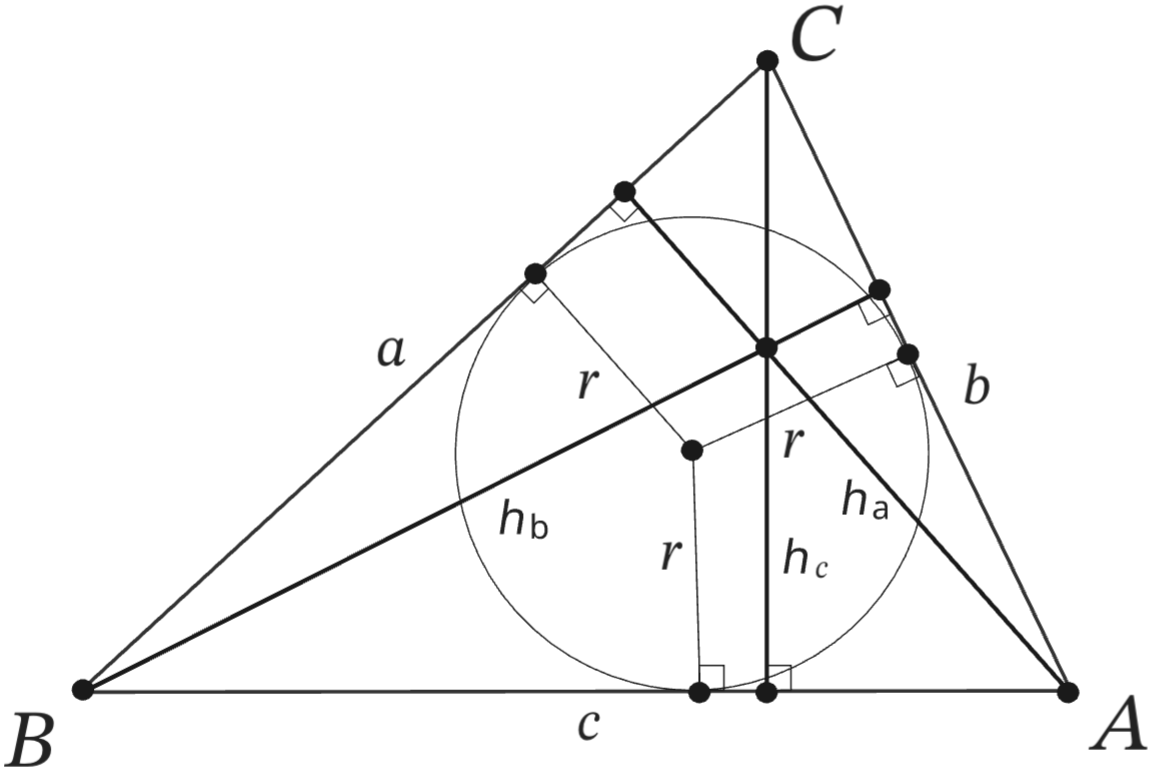
A 3 + B 3 + C 3 ≥ 3 A B C , therefore a + b + c ≥ 3 a b c 3 = 3. A^3+B^3+C^3 \geq 3ABC, \ \text{therefore} \ a+b+c \geq 3\sqrt[3]{abc}=3. A 3 + B 3 + C 3 ≥ 3 A B C , therefore a + b + c ≥ 3 3 ab c = 3. Application 2. Let A B C ABC A B C a a a b b b c c c h a h_a h a h b h_b h b h c h_c h c
a h a + b h b + c h c ≥ a + b + c 3 r , \frac{a}{h_a}+\frac{b}{h_b}+\frac{c}{h_c} \geq \frac{a+b+c}{3r}, h a a + h b b + h c c ≥ 3 r a + b + c , where r r r
Solution. We need to prove that
a h a + b h b + c h c ≥ a + b + c 3 r . \frac{a}{h_a}+\frac{b}{h_b}+\frac{c}{h_c} \geq \frac{a+b+c}{3r}. h a a + h b b + h c c ≥ 3 r a + b + c . According to Sedrakyan's inequality (Titu's lemma), we have
a 2 a h a + b 2 b h b + c 2 c h c ≥ ( a + b + c ) 2 a h a + b h b + c h c . \frac{a^2}{ah_a}+\frac{b^2}{bh_b}+\frac{c^2}{ch_c}\geq \frac{(a+b+c)^2}{ah_a + bh_b + ch_c}. a h a a 2 + b h b b 2 + c h c c 2 ≥ a h a + b h b + c h c ( a + b + c ) 2 . So, to prove the initial inequality it is enough to prove that
( a + b + c ) 2 a h a + b h b + c h c ≥ a + b + c 3 r . \frac{(a+b+c)^2}{ah_a + bh_b + ch_c} \geq \frac{a+b+c}{3r}. a h a + b h b + c h c ( a + b + c ) 2 ≥ 3 r a + b + c . Canceling a + b + c a+b+c a + b + c
a h a + b h b + c h c 3 ≤ ( a + b + c ) r . \frac{ah_a + bh_b + ch_c}{3}\leq (a+b+c)r. 3 a h a + b h b + c h c ≤ ( a + b + c ) r . Divide both hand-sides by 2 to get
a h a + b h b + c h c 6 ≤ ( a + b + c ) r 2 . \frac{ah_a + bh_b + ch_c}{6}\leq \frac{(a+b+c)r}{2}. 6 a h a + b h b + c h c ≤ 2 ( a + b + c ) r . Let S S S
S = a h a 2 = b h b 2 = c h c 2 = ( a + b + c ) r 2 . S = \dfrac{a h_{a}}{2} = \dfrac{b h_{b}}{2} = \dfrac{c h_{c}}{2} = \dfrac{(a+b+c)r}{2}. S = 2 a h a = 2 b h b = 2 c h c = 2 ( a + b + c ) r . Thus, it follows that
a h a + b h b + c h c 6 ≤ S , \frac{ah_a + bh_b + ch_c}{6}\leq S, 6 a h a + b h b + c h c ≤ S , We need to prove 3 S 3 ≤ S , \frac{3S}{3}\leq S, 3 3 S ≤ S , S ≤ S . S \leq S. S ≤ S .
Application 3 (knot theory). This inequality can be used in knot-theory as well. The ropelength of a knot is the minimum length required to tie it. Example estimate structure, by applying Sedrakyan's inequality (Titu's lemma) we get the following:
∑ k i 2 l i ≥ ( ∑ k i ) 2 ∑ l i \sum \frac{k_i^2}{l_i}\geq\frac{(\sum k_i)^2}{\sum l_i} ∑ l i k i 2 ≥ ∑ l i ( ∑ k i ) 2 where k i k_i k i l i l_i l i
Application 4 (Bounds on sums of squared distances). In distance geometry we often analyze expressions like
∑ i = 1 n d i 2 w i \sum_{i=1}^{n}\frac{d_i^2}{w_i} i = 1 ∑ n w i d i 2 where d i d_i d i w i w_i w i
∑ d i 2 w i ≥ ( ∑ d i ) 2 ∑ w i . \sum\frac{d_i^2}{w_i} \geq \frac{(\sum d_i)^2}{\sum w_i}. ∑ w i d i 2 ≥ ∑ w i ( ∑ d i ) 2 . This gives lower bounds for total distance-based energies.
Application 5 (Sensor network localization). In many problems of distance-based positioning, we know distances from sensors to anchors. Typical least-squares objective:
∑ ( d i − d i ^ ) 2 w i \sum \frac{(d_i-\hat{d_i})^2}{w_i} ∑ w i ( d i − d i ^ ) 2 By applying Sedrakyan's inequality (Titu's lemma) we get the following:
∑ ( d i − d i ^ ) 2 w i ≥ ( ∑ ( d i − d i ^ ) ) 2 ∑ w i \sum \frac{(d_i-\hat{d_i})^2}{w_i}\geq\frac{(\sum(d_i-\hat{d_i}))^2}{\sum w_i} ∑ w i ( d i − d i ^ ) 2 ≥ ∑ w i ( ∑ ( d i − d i ^ ) ) 2 with implications for error propagation, stability of reconstruction, and robustness of localization algorithms.
Application 6 (Stress functions in multidimensional scaling). In Multidimensional Scaling (MDS), we reconstruct coordinates from pairwise distances. The objective often looks like
∑ i < j ( d i j − δ i j ) 2 w i j \sum_{i<j}\frac{(d_{ij}-\delta_{ij})^2}{w_{ij}} i < j ∑ w ij ( d ij − δ ij ) 2 By applying Sedrakyan's inequality (Titu's lemma) we get the following:
∑ i < j ( d i j − δ i j ) 2 w i j ≥ ( ∑ i < j ( d i j − δ i j ) ) 2 ∑ i < j w i j \sum_{i<j}\frac{(d_{ij}-\delta_{ij})^2}{w_{ij}}\geq\frac{(\sum_{i<j}(d_{ij}-\delta_{ij}))^2}{\sum_{i<j}w_{ij}} i < j ∑ w ij ( d ij − δ ij ) 2 ≥ ∑ i < j w ij ( ∑ i < j ( d ij − δ ij ) ) 2 where d i j d_{ij} d ij δ i j \delta_{ij} δ ij
Application 7 (Where the generalized n-power form could appear). The power version
∑ a i n b i n − 1 \sum\frac{a_i^n}{b_i^{n-1}} ∑ b i n − 1 a i n By applying the inequality for n n n
∑ a i n b i n − 1 ≥ ( ∑ a i ) n ∑ b i n − 1 \sum\frac{a_i^n}{b_i^{n-1}}\geq\frac{(\sum a_i)^n}{\sum b_i^{n-1}} ∑ b i n − 1 a i n ≥ ∑ b i n − 1 ( ∑ a i ) n could theoretically appear when bounding distance energies, graph embeddings, and network stress functions. These show up in distance geometry optimization, spectral graph theory, and geometric analysis.
Application 8 (Polygonal knot energy estimates). In geometric knot theory (a metric side of knot theory), knots are often approximated by polygons with edges e i e_i e i
E = ∑ i ≠ j l i n d i j n − 1 . E=\sum_{i \neq j}\frac{l_{i}^n}{d_{ij}^{n-1}}. E = i = j ∑ d ij n − 1 l i n . By applying the inequality for n n n
E = ∑ i ≠ j l i n d i j n − 1 ≥ ( ∑ i ≠ j l i ) n ∑ i ≠ j d i j n − 1 . E=\sum_{i \neq j}\frac{l_{i}^n}{d_{ij}^{n-1}}\geq\frac{(\sum_{i \neq j}l_{i})^n}{\sum_{i \neq j}d_{ij}^{n-1}}. E = i = j ∑ d ij n − 1 l i n ≥ ∑ i = j d ij n − 1 ( ∑ i = j l i ) n . Application 9 (Discrete distance-energy bounds (distance geometry)). In distance geometry, one studies configurations of points p 1 , . . , p m p_1,.., p_m p 1 , .. , p m d i j d_{ij} d ij
E = ∑ i < j d i j n w i j n − 1 E=\sum_{i<j}\frac{d_{ij}^n}{w_{ij}^{n-1}} E = i < j ∑ w ij n − 1 d ij n where w i j > 0 w_{ij}>0 w ij > 0
E ≥ ( ∑ i < j d i j ) n ( ∑ i < j w i j ) n − 1 E\geq\frac{(\sum_{i<j}d_{ij})^n}{(\sum_{i<j}w_{ij})^{n-1}} E ≥ ( ∑ i < j w ij ) n − 1 ( ∑ i < j d ij ) n This gives a global lower bound on total distance energy based only on the sums of distances and weights. Such bounds appear when studying rigidity problems, embedding distortion, and weighted distance matrices.
Application 10 (Bounding stress functions in graph embeddings). In geometric embedding problems (a topic connected to distance geometry), one minimizes a stress functional
S = ∑ i < j ( d i j − δ i j ) n w i j n − 1 S=\sum_{i<j}\frac{(d_{ij}-\delta_{ij})^n}{w_{ij}^{n-1}} S = i < j ∑ w ij n − 1 ( d ij − δ ij ) n where d i j d_{ij} d ij δ i j \delta_{ij} δ ij
S ≥ ( ∑ ∣ d i j − δ i j ∣ ) n ( ∑ w i j ) n − 1 S\geq\frac{(\sum \vert d_{ij}-\delta_{ij} \vert)^n}{(\sum w_{ij})^{n-1}} S ≥ ( ∑ w ij ) n − 1 ( ∑ ∣ d ij − δ ij ∣ ) n This gives a lower bound on total embedding error. These ideas appear in multidimensional scaling, network embeddings, and rigidity optimization.
References N. Sedrakyan, About the applications of one useful inequality , Kvant Journal, vol. 97, no. 2, pp. 42–44, 1997. H. Sedrakyan and N. Sedrakyan, Algebraic Inequalities , Problem Books in Mathematics, Springer International Publishing, 2018. doi: 10.1007/978-3-319-77836-5 A. Engel, Problem-Solving Strategies , Problem Books in Mathematics, Springer, 1998. doi: 10.1007/b97682. T. Andreescu and B. Enescu, Mathematical Olympiad Treasures , 2nd ed., Birkhäuser Boston, 2007. doi: 10.1007/978-0-8176-8253-8. H. Sedrakyan and N. Sedrakyan, Geometric Inequalities: Methods of Proving , Problem Books in Mathematics, Springer International Publishing, 2017. doi: 10.1007/978-3-319-55080-0. Download the full paper (PDF)
Explore more of the Sedrakyans' work on the home page .
© 2026 sedrakyans.org · Hayk Sedrakyan, Nairi Sedrakyan, Raphael Pinarbasi. All rights reserved.