Sums of the form , have been studied for centuries, where and are positive integers. We introduce a self-constructive, Pascal-type triangle. This operates similarly to how Pascal's triangle handles expansions of the form , offering an approach despite the existence of Newton's binomial theorem.
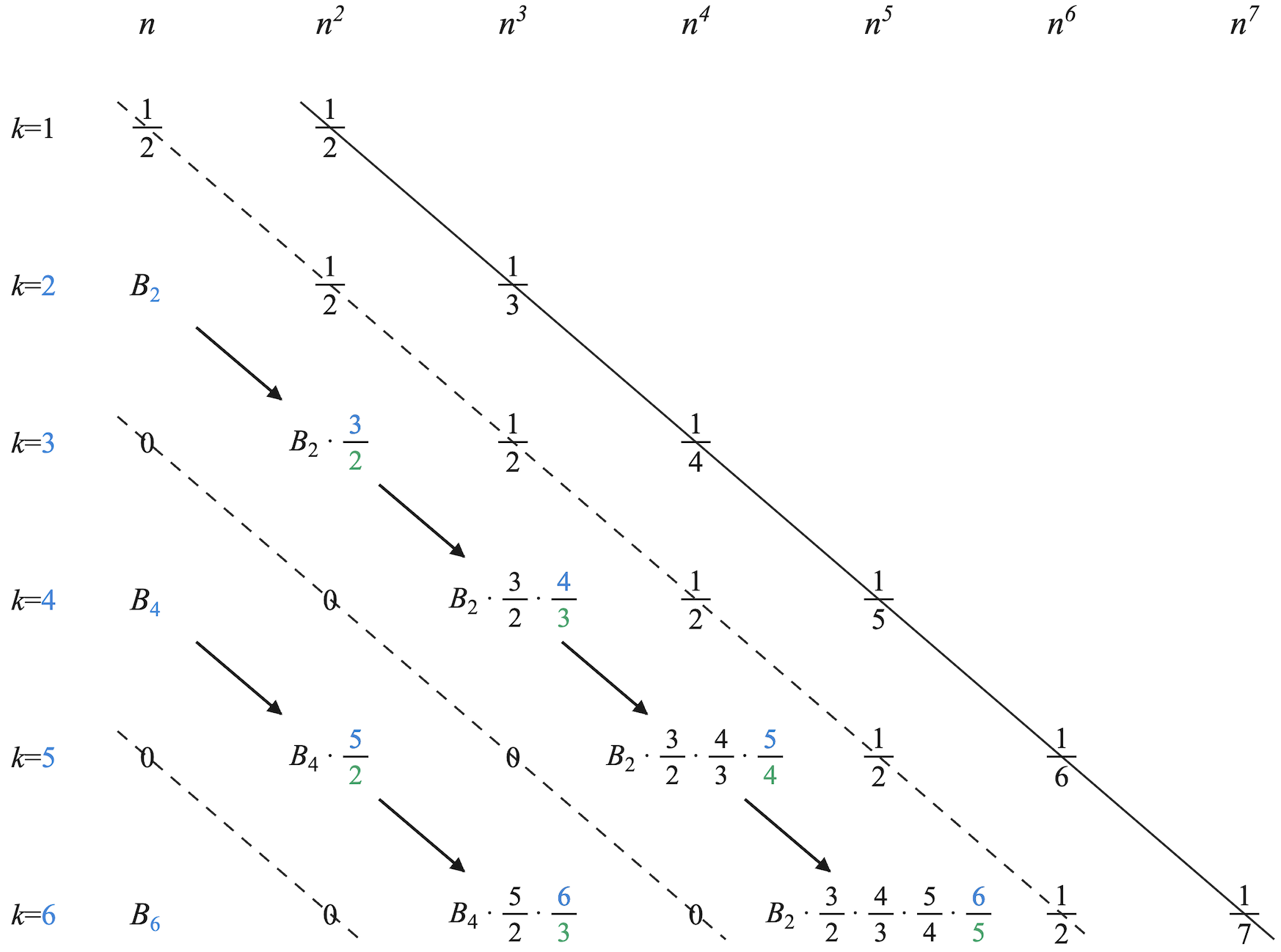
Self-Construction Principle (see the figure below: Sedrakyan's Power Sums Triangle).
The construction of the triangle is governed by the following rules:
- Initial Condition: The first row starts with and , representing the formula for the sum of the first integers:
- Rightmost Leading Diagonal: The coefficients along this diagonal are equal .
- First Rightmost Dashed Diagonal: The coefficients along this diagonal remain constant at .
- Row Initialization: Subsequent rows start with , where are the Bernoulli numbers.
- Recursive Step: New row terms are built recursively by multiplying the previous diagonal term by , where is the row index and is the power of .
for odd , so odd rows begin with 0 while even rows start with
Sedrakyan's Power Sums Triangle
Application. Example ()
Calculate the sum .
Solution. We have
Thus
References
- Bretschneider, C. A., Untersuchung der trigonometrischen Relationen des geradlinigen Viereckes. Archiv der Math. 2, 225–261, 1842.
- Coolidge, J. L., A Historically Interesting Formula for the Area of a Quadrilateral. Amer. Math. Monthly 46, 345–347, 1939.
- Acerbi, F., Vitrac, B. Heron of Alexandria: Metrica, Heron's formula. Serra, 2014.
- Heath, T. L. A history of Greek mathematics (Vol. 2). Clarendon Press, 1921.
- H. Sedrakyan, N. Sedrakyan, Mathematics Competitions Must-Know Geometry: Practice and theory inspired by the style of AMC and AIME geometry (unofficial guide), 2023.
- H. Sedrakyan, N. Sedrakyan, Algebraic inequalities, Springer International Publishing, 2018.
Explore more of the Sedrakyans' work on the home page.
© 2026 sedrakyans.org · Hayk Sedrakyan. All rights reserved.