In this paper, we establish some novel results. In particular: a generalization of parallelogram law (we call it Trapezoid law), and a stronger result (diagonal formulas for expressing each diagonal of a trapezoid separately using its side lengths, we call it a Trapezoid theorem). We also investigate their applications.
Introduction
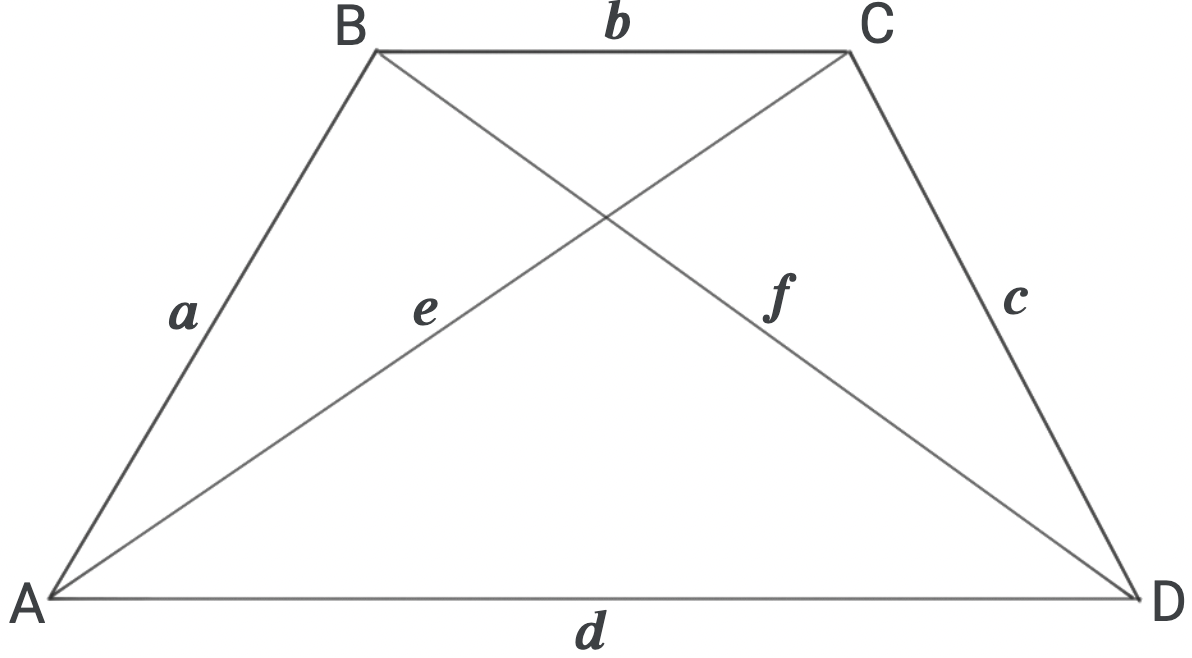
Consider the following trapezoid with side lengths a, b, c, d and diagonals e, f.
Trapezoid law (generalization of parallelogram's law).
We have
a2+c2=e2+f2−2bd.
Trapezoid theorem (stronger result).
We have
e2=bd+b−dc2b−a2d,
f2=bd+b−da2b−c2d.
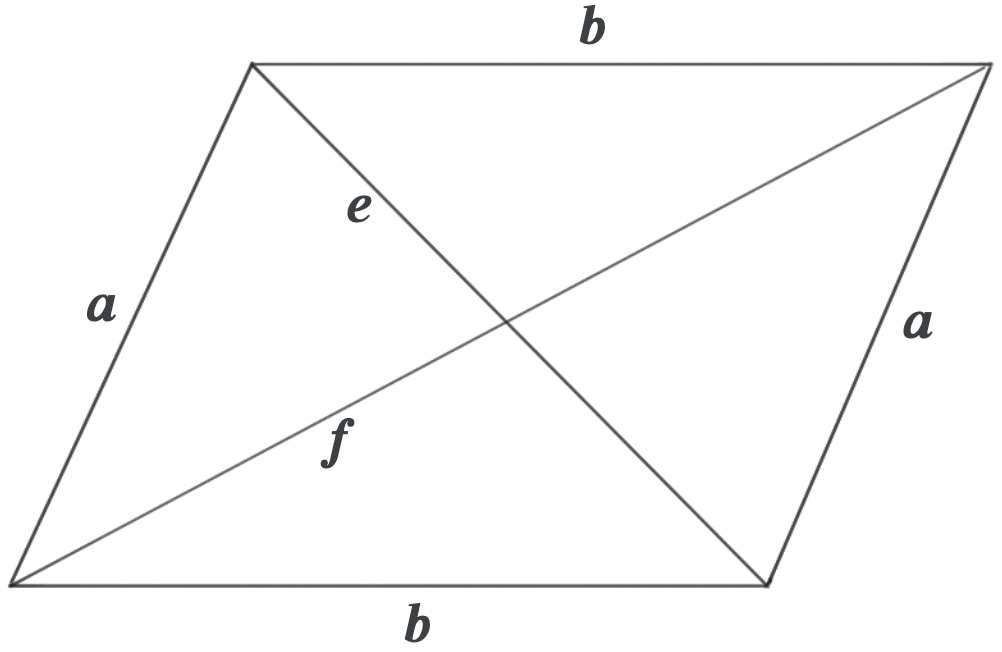
Remark 1. Note that Trapezoid law is the generalization of Parallelogram law. Recall that the Parallelogram law states that
2a2+2b2=e2+f2.
The trapezoid below (see the figure) becomes a parallelogram, if b=d. In that case, we get a=c.
Trapezoid law states that
a2+c2=e2+f2−2bd.
If we take b=d and a=c, then we get
2a2=e2+f2−2b2.
Therefore, we get the Parallelogram law.
2a2+2b2=e2+f2.
Remark 2. In the literature, there are 2 different definitions of a trapezoid. The first definition states that trapezoid is a quadrilateral that has exactly one pair of parallel sides, while the second definition states that trapezoid is a quadrilateral that has at least one pair of parallel sides. Trapezoid law shows that a parallelogram can actually be considered as a particular case of a trapezoid, therefore it looks like that the second definition is more appropriate as a definition of a trapezoid.
Main results and proofs
Consider the following trapezoid with side lengths a, b, c, d and diagonals e, f.
Trapezoid law (generalization of parallelogram's law).
We have
a2+c2=e2+f2−2bd.
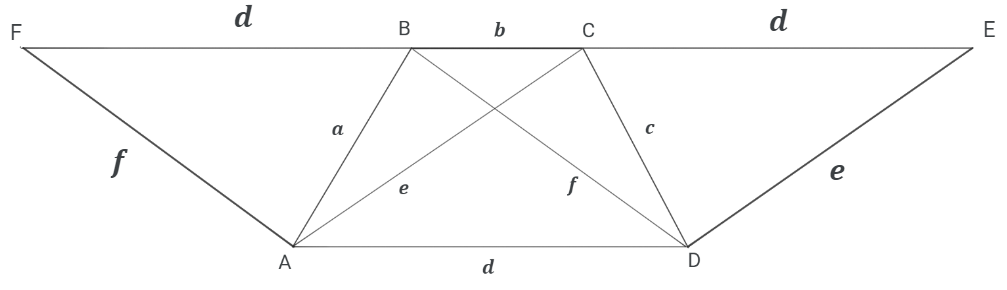
Proof. Let us start by drawing AF parallel to BD and DE parallel to AC.
Using Stewart's theorem for triangles AFC and DBE, we get
a2=d+be2⋅d+f2⋅b−d⋅b,
c2=d+be2⋅b+f2⋅d−d⋅b.
Summing up the last two equations, we get
a2+c2=e2+f2−2bd.
This ends the proof.
Trapezoid theorem (stronger result).
We have
e2=bd+b−dc2b−a2d,
f2=bd+b−da2b−c2d.
Proof. From the equations of Stewart's theorem on previous page for triangles AFC and DBE, we get
f2=d(d+b)(db+c2)−e2b=b(d+b)(db+a2)−e2d.
Thus, it follows that
d(d+b)(db+c2)−e2b−b(d+b)(db+a2)−e2d=0.
Therefore
d(d+b)(db+c2)−b(d+b)(db+a2)=de2b−be2d.
We get
d(d+b)(db+c2)−b(d+b)(db+a2)=dbe2(b2−d2).
Hence
b(d+b)(db+c2)−d(d+b)(db+a2)=e2(b−d)(b+d).
Let us cancel d+b, then
b(db+c2)−d(db+a2)=e2(b−d).
Therefore
e2=b−db(db+c2)−d(db+a2).
Thus
e2=b−dbd(b−d)−(a2d−c2b)=bd+b−dc2b−a2d.
So, we get
e2=bd+b−dc2b−a2d.
Now, we do the same with for f
e2=d(d+b)(db+a2)−f2b=b(d+b)(db+c2)−f2d.
We obtain
d(d+b)(db+a2)−f2b−b(d+b)(db+c2)−f2d=0.
Hence
d(d+b)(db+a2)−b(d+b)(db+c2)=df2b−bf2d.
Thus
d(d+b)(db+a2)−b(d+b)(db+c2)=dbf2(b2−d2).
We get
b(d+b)(db+a2)−d(d+b)(db+c2)=f2(b−d)(b+d).
Let us cancel d+b
b(db+a2)−d(db+c2)=f2(b−d).
Therefore
f2=b−db(db+a2)−d(db+c2).
Thus, it follows that
f2=b−dbd(b−d)+a2b−c2d=bd+b−da2b−c2d.
So, we get
f2=bd+b−da2b−c2d.
This ends the proof.
Applications
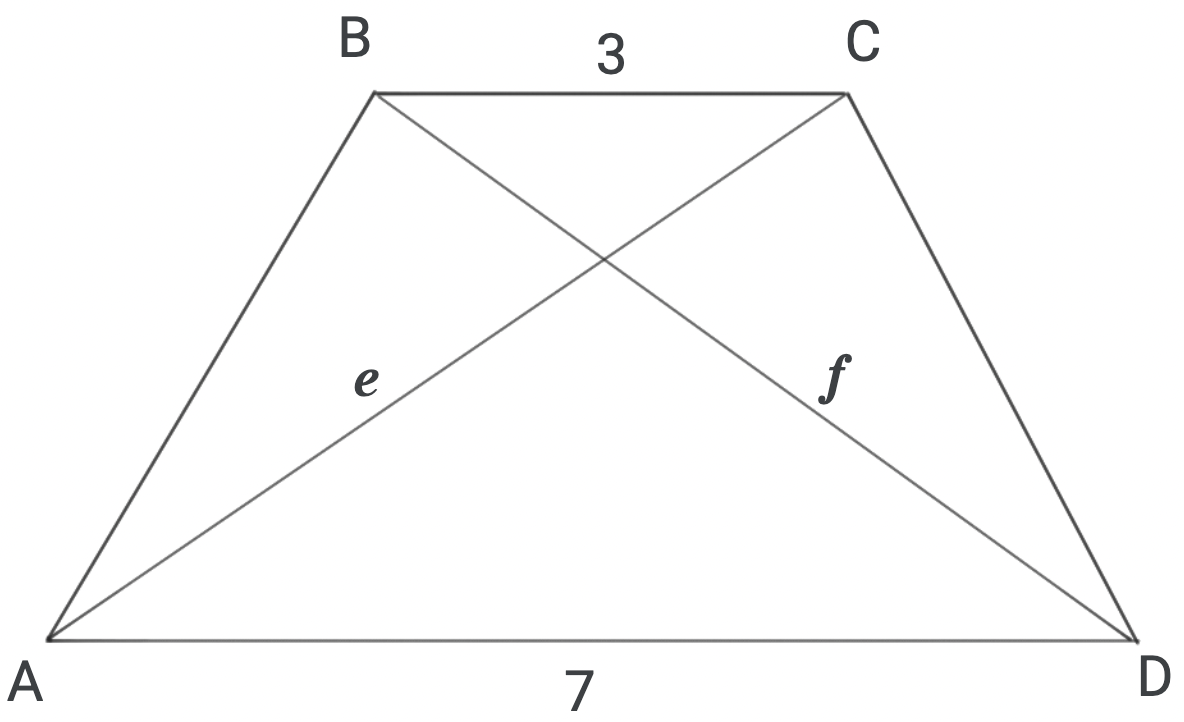
Application 1 (Sedrakyan, The Stair-Step Approach in Mathematics). Consider a trapezoid with bases equal to 3 and 7. Given that the sum of the squares of its diagonals is equal to 100. Find the sum of the squares of its legs.
Solution. Let us consider the following trapezoid (see figure below).
By trapezoid law, we have that
AB2+CD2=e2+f2−2⋅BC⋅AD.
We get
AB2+CD2=100−42=58.
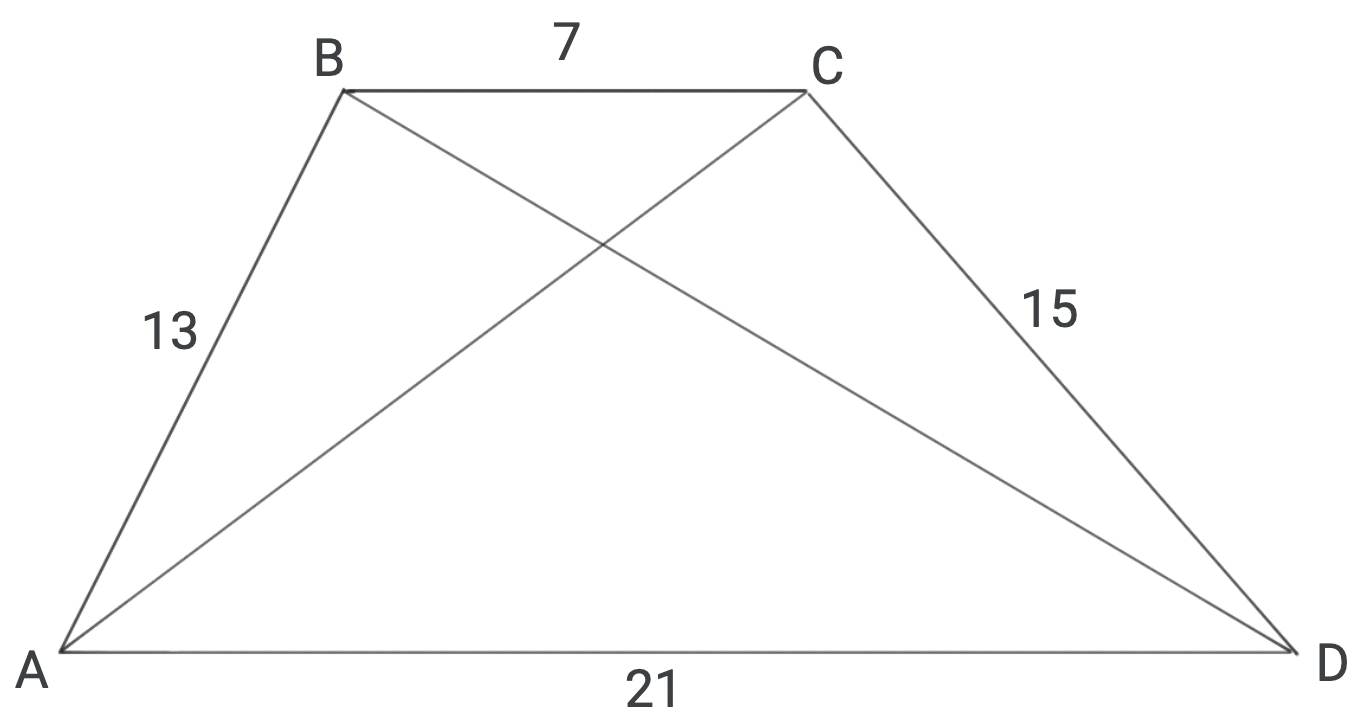
Application 2. Let ABCD be a trapezoid, where AB = 13, BC = 7, CD = 15, AD = 21 (see the figure). What is the length of diagonals AC and BD?
Solution. To find diagonal AC we use the Trapezoid theorem
AC2=7⋅21+7−21152⋅7−132⋅21=288.
So, we get that
AC2=288,soAC=122.
To find diagonal BD we use the Trapezoid theorem
BD2=7⋅21+7−21132⋅7−152⋅21=400.
Thus, it follows that
BD2=400,soBD=20.
References
Sedrakyan H., Sedrakyan N., 12 Independent Practice Tests for AMC 8 Preparation: An Unofficial Study Guide, USA (2026).
Sedrakyan H., Sedrakyan N., 12 Independent Practice Tests for AMC 10 Preparation: An Unofficial Study Guide, USA (2026).
Sedrakyan H., Sedrakyan N., 12 Independent Practice Tests for AMC 12 Preparation: An Unofficial Study Guide, USA (2026).
Sedrakyan H., Sedrakyan N., Mathematics Competitions Must-Know Geometry: Practice and theory inspired by the style of AMC and AIME geometry: An Unofficial Study Guide, USA (2023).
Sedrakyan H., Sedrakyan N., 12 Independent Practice Tests for AIME Preparation: An Unofficial Study Guide, USA (2022).
Sedrakyan H., Sedrakyan N., Competition math for middle school: must-knows and beyond, USA (2023).
Sedrakyan H., Sedrakyan N., How to prepare for math Olympiads, USA (2019).